# NZ Business Alliance: full site content
> Every page of https://alliance.org.nz as markdown, for AI agents. Index: https://alliance.org.nz/llms.txt. Agent guide: https://alliance.org.nz/agents/. Generated at build time; each section starts with the page's URL.
---
title: "Tips | NZ Business Alliance"
description: "Plain-English marketing, sales and lead generation tips for New Zealand small businesses."
source: https://alliance.org.nz/tips/
---
Small business advice
# Tips
Practical guides on getting found online, ads that pay for themselves, websites that convert, and using AI without the hype.
[
Local SEO8 min read
### How to Rank a Google Business Profile Without a Business Address
No shopfront? You can still rank on Google Maps. How to set up a service area business in NZ, what gets you suspended, and what actually moves you up.
](https://alliance.org.nz/small-business-advice/how-to-rank-google-business-profile-without-address-nz/) [
Online Marketing2 min read
### Why Great Marketing Isn’t About More Traffic
One of the biggest misconceptions in marketing is that success comes from simply getting more clicks. More traffic only matters if it turns into more customers. Over the…
](https://alliance.org.nz/small-business-advice/why-great-marketing-isnt-about-more-traffic/) [
Online Marketing2 min read
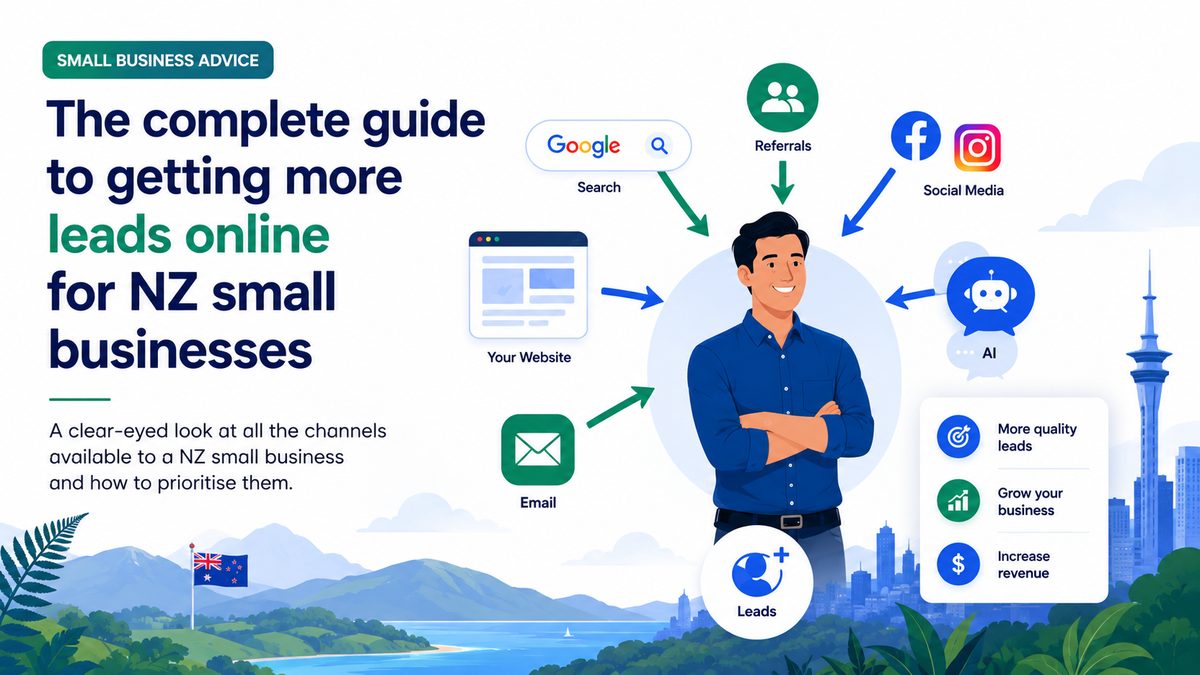
### The complete guide to getting more leads online for NZ small businesses
Leads are the lifeblood of most small businesses. Online is where most of them start now. Here’s a clear-eyed look at all the channels available to a NZ small business…
](https://alliance.org.nz/small-business-advice/online-leads-nz-small-business-complete-guide/) [
AI for Business2 min read
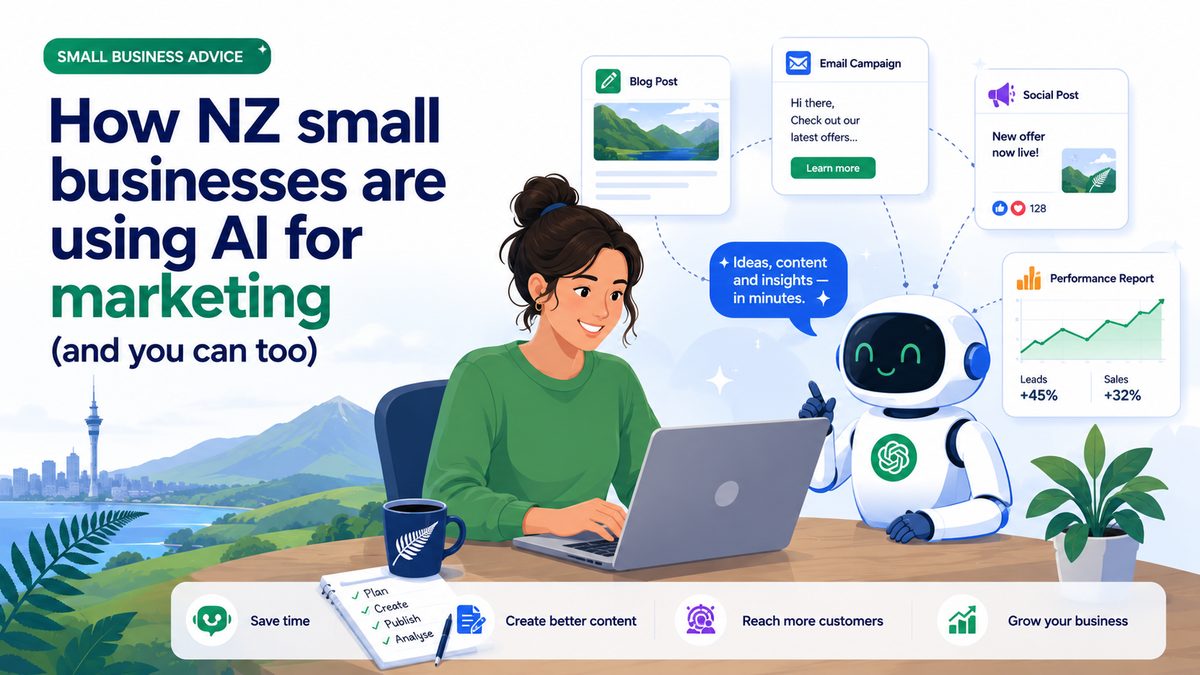
### How NZ small businesses are using AI for marketing (and you can too)
AI isn’t just for tech companies. Plenty of regular NZ small businesses are already using it to write better ads, create content faster, and follow up on leads more…
](https://alliance.org.nz/small-business-advice/ai-marketing-nz-small-business/) [
Website & Data2 min read
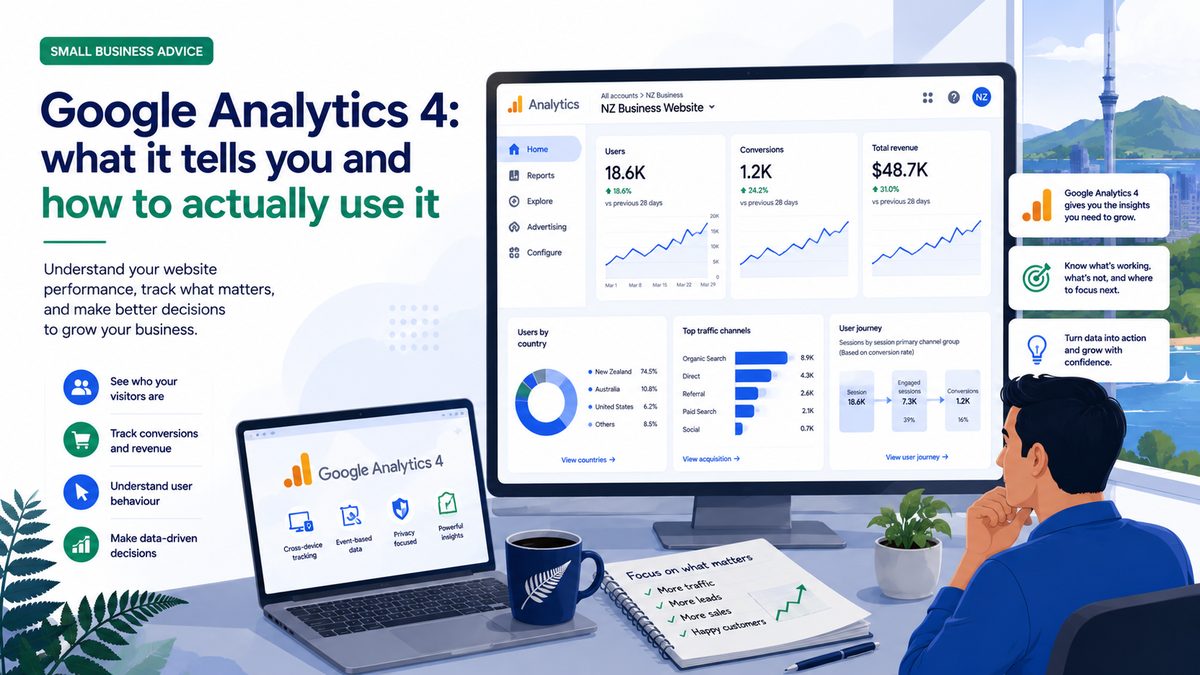
### Google Analytics 4: what it tells you and how to actually use it
If you have a website, you should have Google Analytics on it. But most small business owners install it and never look at it. Here’s what to focus on — and what to…
](https://alliance.org.nz/small-business-advice/google-analytics-4-nz-small-business/) [
AI for Business3 min read
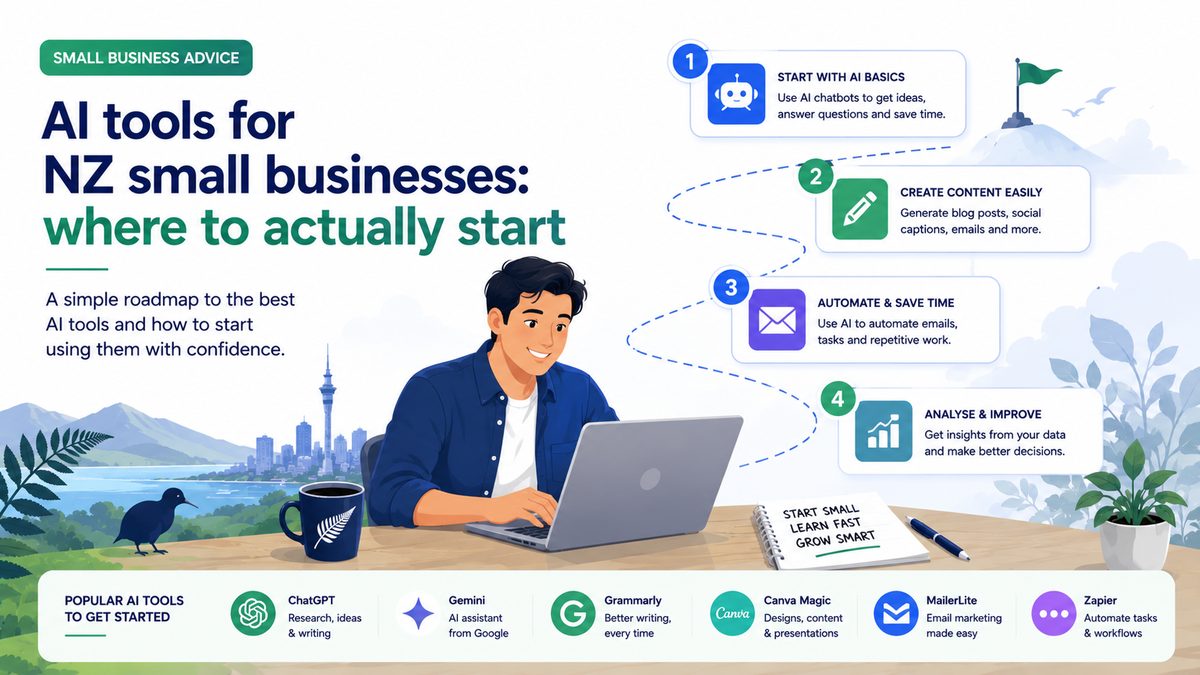
### AI tools for NZ small businesses: where to actually start
61% of NZ small businesses are already using AI. The other 39% are wondering what all the fuss is about, or finding the whole thing overwhelming. Here’s a straightforward…
](https://alliance.org.nz/small-business-advice/ai-tools-nz-small-business-where-to-start/) [
Website & Conversion2 min read
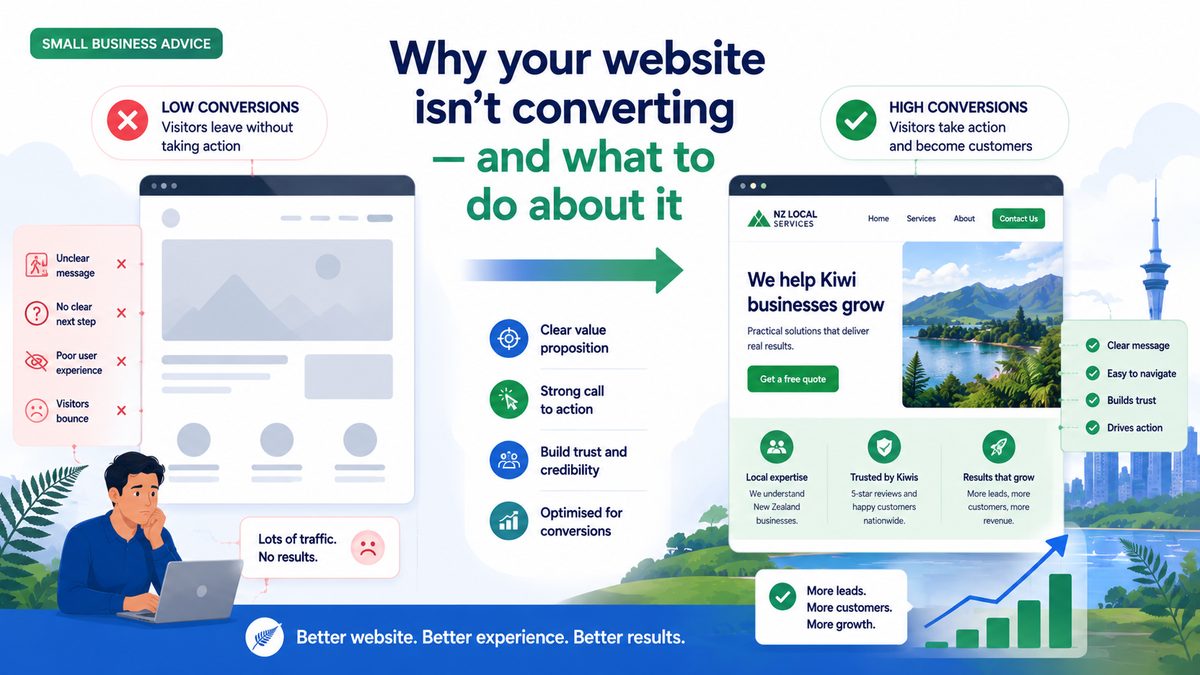
### Why your website isn’t converting — and what to do about it
Getting traffic to your website is only half the battle. The other half is turning that traffic into enquiries and sales. Most NZ small business websites have at least…
](https://alliance.org.nz/small-business-advice/website-conversion-nz-small-business/) [
Email Marketing2 min read
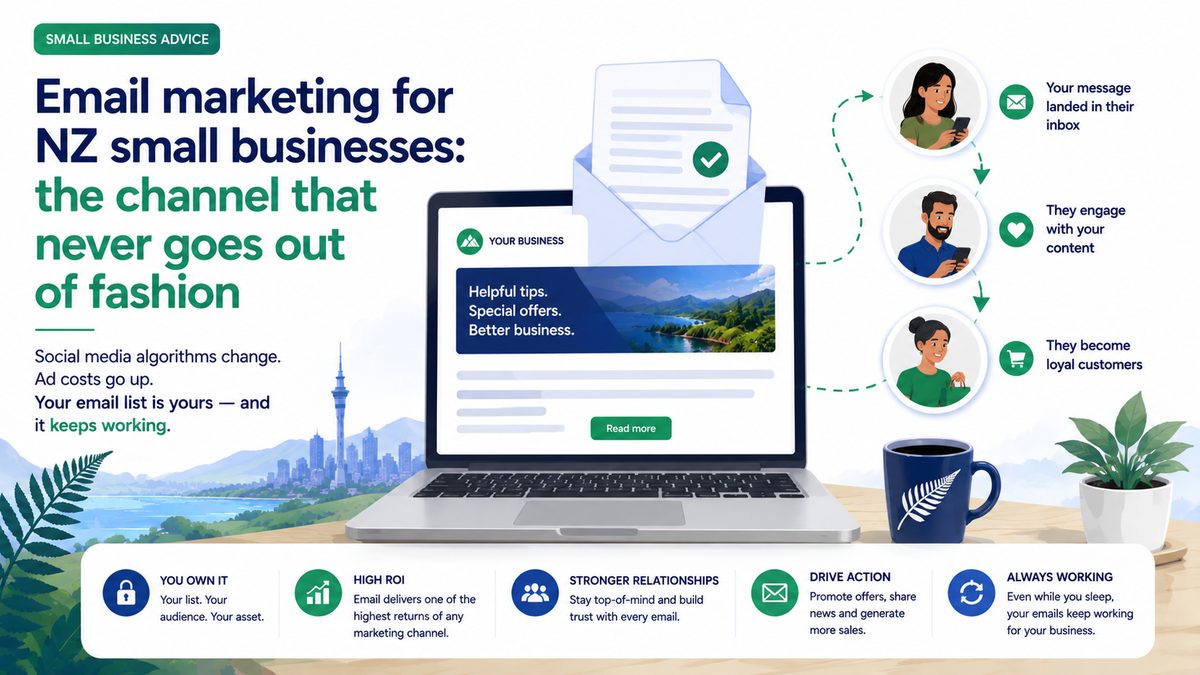
### Email marketing for NZ small businesses: the channel that never goes out of fashion
Social media algorithms change. Ad costs go up. Your email list is yours — and it keeps working. Here’s how to build one and make it count for a NZ small business.
](https://alliance.org.nz/small-business-advice/email-marketing-nz-small-business/) [
Meta Ads3 min read
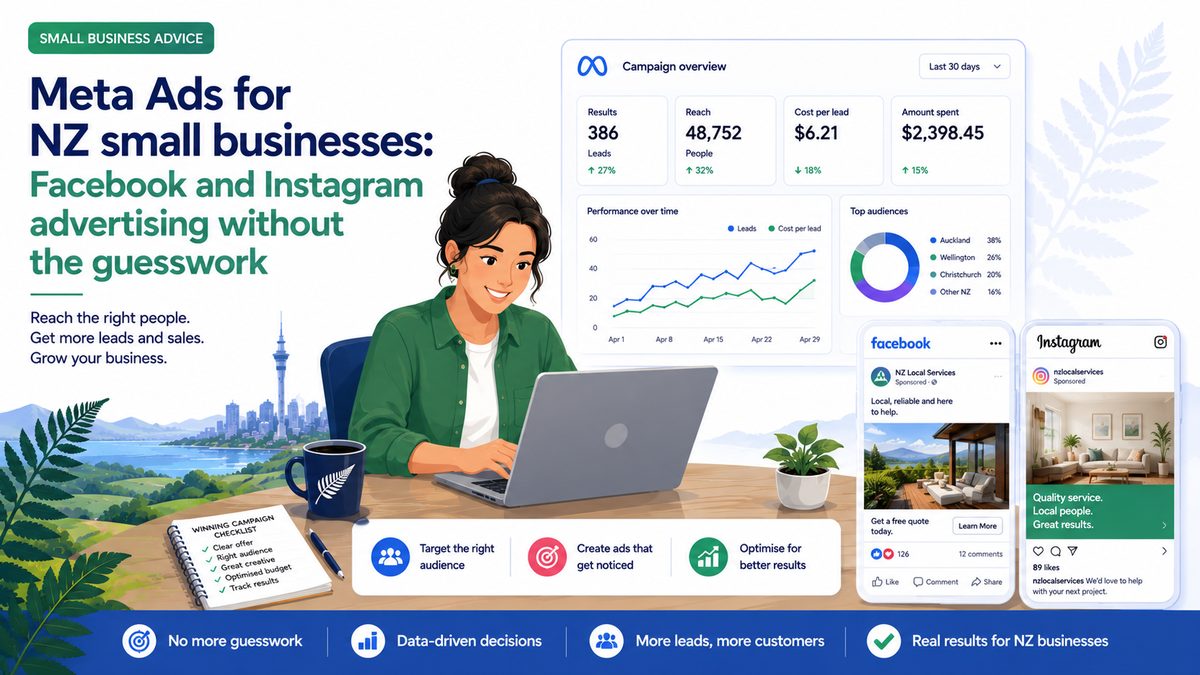
### Meta Ads for NZ small businesses: Facebook and Instagram advertising without the guesswork
Meta Ads can work brilliantly for NZ small businesses — or they can eat your budget with nothing to show for it. The difference comes down to a few key decisions. Here’s…
](https://alliance.org.nz/small-business-advice/meta-ads-nz-small-business/) [
Google Ads3 min read
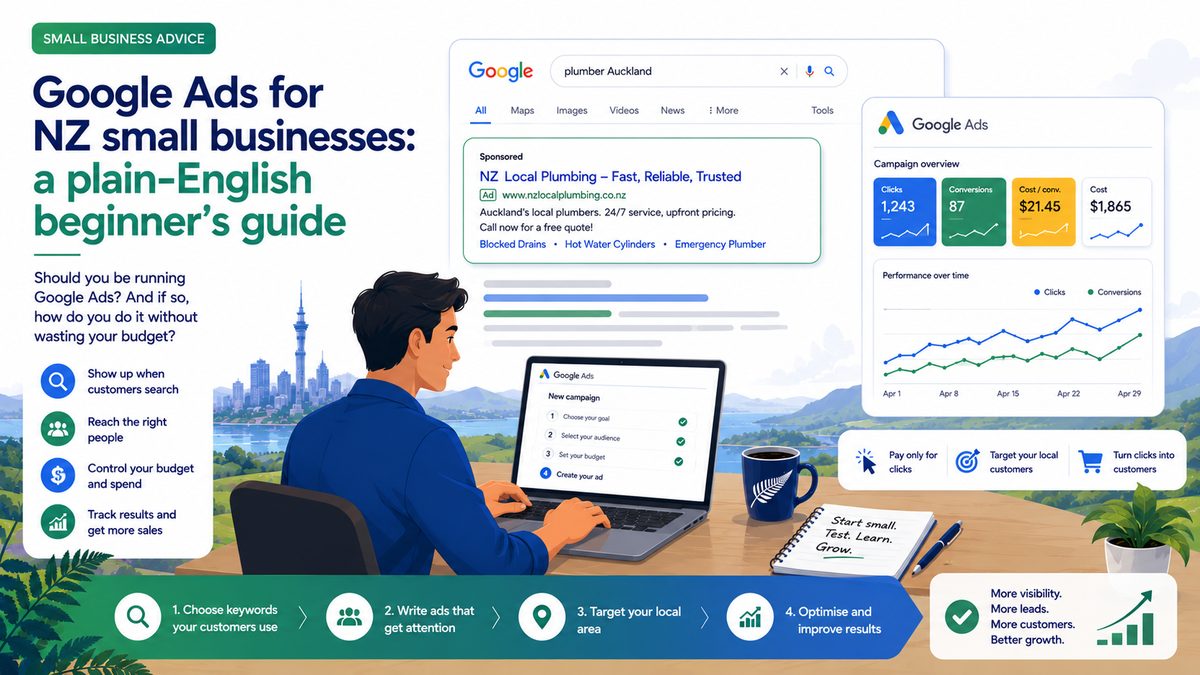
### Google Ads for NZ small businesses: a plain-English beginner’s guide
Should you be running Google Ads? And if so, how do you do it without wasting your budget? Here’s what every NZ small business owner needs to know before they start.
](https://alliance.org.nz/small-business-advice/google-ads-nz-small-business-beginners-guide/) [
Local SEO3 min read
### Local SEO for NZ small businesses: what actually works in 2026
Forget the technical jargon. Here’s what local SEO actually means for a small Kiwi business, and the practical things you can do this week to show up higher in Google.
](https://alliance.org.nz/small-business-advice/local-seo-nz-small-business/) [

Local SEO3 min read
### Google Business Profile: the free tool every NZ business should actually be using
It’s free, it takes an afternoon to set up, and it’s probably the single highest-ROI marketing task available to a NZ small business. Here’s how to do it properly.
](https://alliance.org.nz/small-business-advice/google-business-profile-nz/) [
Local SEO2 min read
### How Christchurch Businesses Can Rank Higher in Google Local Listings
If you’re a business owner in Christchurch, appearing in Google’s local listings can be a game-changer. When someone searches for “plumber near me” or “best café in…
](https://alliance.org.nz/small-business-advice/how-christchurch-businesses-can-rank-higher-in-google-local-listings/) [
Google Ads2 min read
### Why Hiring a Local PPC Expert in Christchurch Might Be the Best Call You Make This Year
Running Google Ads can feel like trying to assemble flat-pack furniture without the instructions — confusing, frustrating, and you’re never quite sure if you’ve done it…
](https://alliance.org.nz/small-business-advice/why-hiring-a-local-ppc-expert-in-christchurch-might-be-the-best-call-you-make-this-year/) [
Local SEO2 min read
### How to Rank Your Business on Google Maps (Without Losing the Plot)
How to Rank Your Business on Google Maps (Without Losing the Plot) Let’s be honest, if your business isn’t showing up on Google Maps, you might as well be running it from…
](https://alliance.org.nz/small-business-advice/how-to-rank-your-business-on-google-maps-without-losing-the-plot/)
---
---
title: "How to Rank a Google Business Profile Without a Business Address | NZ Business Alliance"
description: "No shopfront? You can still rank on Google Maps. How to set up a service area business in NZ, what gets you suspended, and what actually moves you up."
source: https://alliance.org.nz/small-business-advice/how-to-rank-google-business-profile-without-address-nz/
---
[Local SEO](https://alliance.org.nz/tips/#local-seo)
# How to Rank a Google Business Profile Without a Business Address
No shopfront? You can still rank on Google Maps. How to set up a service area business in NZ, what gets you suspended, and what actually moves you up.
18 September 20268 min read
You run a real business. You just don’t have a shop. Maybe you’re a sparkie working out of a van, a mobile groomer, a plumber whose “office” is the garage, or a consultant who meets clients at their place. And every guide you read about Google Maps starts with “add your address”, which is exactly the thing you can’t do.
Good news: Google has a whole category for you. It’s called a service area business, and you can absolutely rank without putting your home address on the internet. It just works differently, and most people get the setup wrong in the first ten minutes and then wonder why they’re invisible.
Here’s how to do it properly.
## First, set it up as a service area business
Google splits businesses into three types. A storefront (customers come to you), a service area business or SAB (you go to customers), and a hybrid (both, like a bakery that also does catering call-outs).
If customers never come to your address, you’re an SAB. Google’s guidelines are blunt about it: _“If you don’t serve customers at your business address, remove your address from your Business Profile.”_
Note the word **remove**, not hide. There used to be a tick box that hid your address. These days you take it out entirely and set service areas instead. You’ll still enter your address during verification so Google knows where you’re based, but it won’t show publicly.
### The rules you need to know
- **Up to 20 service areas.** You set them by city, suburb or postcode. Not a radius.
- **About two hours’ driving, max.** Google says the outer boundary of your whole service area shouldn’t be more than roughly two hours’ drive from where you’re based. A Christchurch sparkie can cover Rangiora and Ashburton. Not Nelson.
- **You have to actually be reachable during your stated hours.** Google’s wording is that the business must be “staffed by your team and able to receive customers during its stated hours.” If your hours say 8 to 5 and nobody answers the phone, that’s a problem.
- **Edits take up to 48 hours** to show once approved.
### The stuff that gets you suspended
This is where people come unstuck, usually because someone told them a clever workaround.
- **PO Boxes.** Straight out. Google: “P.O. boxes or mailboxes located at remote locations aren’t acceptable.”
- **Virtual offices.** Not eligible unless the office is genuinely staffed during business hours by your people.
- **Co-working spaces.** Only allowed if that specific office has clear signage, receives customers during business hours, and is staffed by your staff. A hot desk at a shared space won’t cut it.
- **Your mate’s address, or your accountant’s.** Don’t. It’s the single most common cause of a suspension, and getting reinstated is a genuinely miserable process.
- **Keyword-stuffing your business name.** Tempting, and it does work for a while, which is why so many of your competitors are doing it. But Google’s guidelines explicitly ban location and service keywords in the name. “Dave’s Plumbing” is fine. “Dave’s Plumbing Christchurch Hot Water Cylinder Repairs” is a suspension waiting to happen.
## Why service area businesses rank differently
Google ranks local results on three things: relevance, distance and prominence.
Distance is measured from the searcher to your business location. Here’s the catch: even though your address is hidden, Google still has a pin on it. So if you’re based in Rolleston, you’ll naturally show up more for people searching in Rolleston than for people searching in Sumner, even though both are inside your stated service area.
You can’t change where you live. What you _can_ change is relevance and prominence, and for SABs those two have to do the heavy lifting. That’s the whole game.
## The seven things that actually move the needle
### 1. Get your primary category exactly right
Your primary category is the biggest single lever on the profile. Not “contractor” when you mean “electrician”. Not “home services” when you mean “plumber”. Look at the top three businesses ranking for your main search term and see what they’ve picked. Then add secondary categories for the rest of what you do, but keep the primary one tight.
### 2. Reviews, and specifically reviews that mention where you worked
Reviews are the prominence signal that you have the most control over. For an SAB they do double duty, because a review saying “came out to our place in Lincoln, sorted the switchboard same day” is one of the few ways Google gets told you genuinely work in Lincoln.
Don’t script it. Just ask at the right moment: when the job’s done and the customer is happy. “If you’ve got 30 seconds, a quick review really helps us out” works better than a formal email three weeks later. Reply to every one, including the bad ones.
### 3. Build real location pages, not doorway pages
This is the big one for SABs, and it’s where your website earns its keep. If you want to rank in five towns, you need pages about those five towns.
What doesn’t work: 40 near-identical pages with the town name swapped out. Google has been eating those for breakfast for a decade.
What does work: a page per town you genuinely work in, with actual specifics. Jobs you’ve done there. Local landmarks or suburbs. The housing stock (villas in Merivale have different wiring problems to new builds in Wigram, and saying so proves you’ve been there). Photos from real jobs. A review or two from customers in that area.
Five good ones beat fifty thin ones. Every time.
### 4. Sort your citations
A citation is any mention of your business name and phone number online. They matter less than they did in 2015, but they still count, and for SABs they’re one of the few consistent signals available.
Worth doing in NZ: Yellow, Localist, Neighbourly, Finda, your regional chamber of commerce, NoCowboys if you’re in trades, and any industry association you belong to. Keep the name and phone number identical everywhere. Leave the address off, same as your profile.
### 5. Photos, regularly, from actual jobs
Profiles with fresh photos get more engagement, and engagement feeds prominence. Take a photo of the van, the finished job, the team. Upload a few every month rather than 50 in one go and then nothing for a year.
### 6. Fill in every service
The services section is free real estate that most people ignore. List every job you do as its own service with a real description. This is how you show up for the specific searches, the “emergency hot water cylinder replacement” ones, rather than only the generic “plumber near me”.
### 7. Post, but don’t overthink it
A Google Post every week or two keeps the profile looking alive. A finished job, a seasonal reminder, a note that you’re booked out until the 20th. It takes two minutes and it’s more than most of your competitors are doing.
## You’re verified but still invisible. Now what?
Almost always one of these four:
1. **You’re searching from your own house.** Of course you show up there. Check how you rank from the middle of the town you actually want work in, not from your kitchen.
2. **Your primary category is wrong.** Go and check it again. It’s wrong more often than you’d think.
3. **You have four reviews and the businesses above you have eighty.** That’s not a mystery, that’s just the gap.
4. **Your website has nothing on it about the places you work.** Google has no reason to connect you to a town you’ve never mentioned.
If you’ve been at it for months with none of these problems, it’s worth checking whether you’ve been soft-suspended. A profile can stay live but stop appearing in Maps results entirely. Search your exact business name in an incognito window. If the profile doesn’t come up, that’s your answer, and you’ll need to lodge a reinstatement request.
## The honest timeline
Verification takes a few days to a couple of weeks. Setup changes show within 48 hours. Rankings move over two to six months, mostly on the back of reviews and location pages.
Anyone promising you the top of the map pack in three weeks is either lying or about to get your profile suspended.
## Common questions
### Can I have a Google Business Profile with no address at all?
Yes. Set it up as a service area business. You’ll provide your address during verification so Google knows where you’re based, then remove it from the public profile and set service areas instead. Your address stays private.
### Can I use my home address if I hide it?
Yes, and it’s the normal setup for most tradies and mobile businesses in New Zealand. Verify at your home address, then remove it from public display. Nobody sees it. What you can’t do is leave it showing while claiming customers visit you there.
### How many service areas can I add?
Up to 20, set by city, suburb or postcode. The outer edge of your total area shouldn’t be more than roughly two hours’ driving time from your base.
### Does hiding my address hurt my rankings?
Not directly. Google still knows where you’re based and still uses that for distance calculations. What changes is that you lose the visual credibility of a listed address, so reviews, categories and your website’s location content have to work harder.
### Can I rank in a city I don’t live in?
Harder, but yes, as long as it’s genuinely within your service area. You’ll need a proper page on your site about that city, reviews from customers there, and patience. You will almost never beat a business physically located in that city for searches made from its centre.
### What’s the difference between a service area business and a hybrid?
A hybrid has premises customers can visit _and_ travels to customers. A workshop that also does mobile call-outs, say. Hybrids show their address and their service areas. Pure service area businesses show only the areas.
## The short version
Set it up as a service area business and remove the address properly. Get the primary category right. Ask every happy customer for a review. Build a genuine page for each town you work in. Keep your details consistent across the NZ directories. Add photos and services.
That’s it. It’s not complicated, it’s just slow, and almost nobody does all of it.
More on the basics in our guide to [ranking your business on Google Maps](https://alliance.org.nz/small-business-advice/how-to-rank-your-business-on-google-maps-without-losing-the-plot/), and if you’re in Canterbury specifically, have a read of [how Christchurch businesses can rank higher in local listings](https://alliance.org.nz/small-business-advice/how-christchurch-businesses-can-rank-higher-in-google-local-listings/).
---
**Stuck with a profile that won’t show up?** We do this all day. [Flick us a message](https://alliance.org.nz/join/) and we’ll take a look at what’s holding it back.
### Got a question about this?
The Alliance assistant has read every guide on this site. Tap “Ask the Alliance” at the bottom of the screen.
### Keep reading
- [Local SEO for NZ small businesses: what actually works in 2026](https://alliance.org.nz/small-business-advice/local-seo-nz-small-business/)
- [Google Business Profile: the free tool every NZ business should actually be using](https://alliance.org.nz/small-business-advice/google-business-profile-nz/)
- [How Christchurch Businesses Can Rank Higher in Google Local Listings](https://alliance.org.nz/small-business-advice/how-christchurch-businesses-can-rank-higher-in-google-local-listings/)
- [How to Rank Your Business on Google Maps (Without Losing the Plot)](https://alliance.org.nz/small-business-advice/how-to-rank-your-business-on-google-maps-without-losing-the-plot/)
### Get one tip a fortnight
Free, practical, unsubscribe any time.
[Join free](https://alliance.org.nz/join/)
---
---
title: "Why Great Marketing Isn’t About More Traffic | NZ Business Alliance"
description: "One of the biggest misconceptions in marketing is that success comes from simply getting more clicks. More traffic only matters if it turns into more customers. Over the last fifteen years I’ve worked with businesses ranging from startups to established brands, and the pattern is always the same. The businesses that consistently grow aren’t…"
source: https://alliance.org.nz/small-business-advice/why-great-marketing-isnt-about-more-traffic/
---
[Online Marketing](https://alliance.org.nz/tips/#online-marketing)
# Why Great Marketing Isn’t About More Traffic
One of the biggest misconceptions in marketing is that success comes from simply getting more clicks. More traffic only matters if it turns into more customers. Over the last fifteen years I’ve worked with businesses ranging from startups to established brands, and the pattern is always the same. The businesses that consistently grow aren’t…
28 July 20262 min read
One of the biggest misconceptions in marketing is that success comes from simply getting more clicks.
More traffic only matters if it turns into more customers.
Over the last fifteen years I’ve worked with businesses ranging from startups to established brands, and the pattern is always the same. The businesses that consistently grow aren’t necessarily the ones spending the most. They’re the ones that measure what matters, optimise relentlessly, and make decisions based on data instead of assumptions.
That means building Google Ads campaigns that generate profitable enquiries, not just impressions. It means running Meta campaigns with proper tracking so you know what’s actually driving revenue. It means having analytics you can trust instead of dashboards full of vanity metrics.
More recently, AI has become another way to improve performance. From AI workflows that remove repetitive manual tasks to AI second brains that give teams instant access to company knowledge, businesses can now spend less time searching for information and more time acting on it.
The same thinking applies to automation. Well-designed business processes reduce manual work, improve consistency and free people to focus on higher-value tasks rather than copying information between systems.
Technology isn’t a strategy on its own. It’s an amplifier. When your campaigns, tracking and processes are already strong, the right tools can help you move faster and make better decisions.
If you’re looking to improve your marketing performance, whether that’s Google Ads, Meta Ads, analytics or AI-powered automation, I’d be happy to have a conversation.
[https://tomr.co.nz/](https://tomr.co.nz/)
### Got a question about this?
The Alliance assistant has read every guide on this site. Tap “Ask the Alliance” at the bottom of the screen.
### Keep reading
- [The complete guide to getting more leads online for NZ small businesses](https://alliance.org.nz/small-business-advice/online-leads-nz-small-business-complete-guide/)
- [How to Rank a Google Business Profile Without a Business Address](https://alliance.org.nz/small-business-advice/how-to-rank-google-business-profile-without-address-nz/)
- [How NZ small businesses are using AI for marketing (and you can too)](https://alliance.org.nz/small-business-advice/ai-marketing-nz-small-business/)
- [Google Analytics 4: what it tells you and how to actually use it](https://alliance.org.nz/small-business-advice/google-analytics-4-nz-small-business/)
### Get one tip a fortnight
Free, practical, unsubscribe any time.
[Join free](https://alliance.org.nz/join/)
---
---
title: "The complete guide to getting more leads online for NZ small businesses | NZ Business Alliance"
description: "Leads are the lifeblood of most small businesses. Online is where most of them start now. Here’s a clear-eyed look at all the channels available to a NZ small business and how to prioritise them."
source: https://alliance.org.nz/small-business-advice/online-leads-nz-small-business-complete-guide/
---
[Online Marketing](https://alliance.org.nz/tips/#online-marketing)
# The complete guide to getting more leads online for NZ small businesses
Leads are the lifeblood of most small businesses. Online is where most of them start now. Here’s a clear-eyed look at all the channels available to a NZ small business and how to prioritise them.
8 April 20262 min read

Every NZ small business owner wants more leads. Most are overwhelmed by the number of channels and don’t know where to focus. Here’s a practical framework for thinking about it — and a starting order that makes sense for most businesses.
## Understand where your leads are coming from now
Before you add a new channel, understand your existing ones. When you get a new enquiry, do you know how they found you? If you don’t have a way to track this — even just asking people “how did you hear about us?” — you’re adding to something you can’t measure. Fix that first.
Common sources for NZ small businesses: Google (organic search and Maps), referrals from existing customers, Facebook/Instagram, Google Ads, directory listings, and word of mouth. Each behaves differently and rewards different approaches.
## The recommended starting order
**1. Google Business Profile.** Free. High ROI. If you appear in the local map pack when people search for your service in your area, that’s free leads. Start here if you haven’t already.
**2. Your website.** Not “do you have one” but “does it actually convert”. A website that’s slow, hard to use on mobile, or unclear about what you do is costing you leads every day. Fix conversion fundamentals before spending money driving traffic to it.
**3. Ask for referrals.** Systematically, not occasionally. After every good job: “If you know anyone who could use our help, we’d really appreciate the referral.” Build it into your process. Referral leads convert at a much higher rate than cold traffic.
**4. Google Ads (if budget allows).** If you have $1,000+/month to invest and your website is in decent shape, Google Search Ads targeting high-intent local keywords is one of the most direct ways to generate leads online. Set up conversion tracking, build a negative keyword list, and monitor weekly.
**5. Content and SEO.** A longer-term play but compounds over time. Blog posts that answer the questions your customers ask, optimised for local search terms, build organic traffic that doesn’t require ongoing ad spend. Two good posts a month, published consistently, will outperform most one-off content blitzes.
**6. Meta Ads.** Best for businesses with strong visuals, a clear offer, and a budget of at least $800–$1,200/month. Effective for building awareness and capturing demand you didn’t know existed. Less suited to emergency or urgent-need services where Google Ads wins.
## The thing most businesses skip
Follow-up. Most enquiries don’t convert on first contact — they convert on the third or fourth touchpoint. A CRM (even a simple spreadsheet) that tracks every enquiry and flags which ones haven’t heard back yet can dramatically improve how many quotes turn into jobs. The discipline of following up is more valuable than any new marketing channel.
There’s no single magic channel. The businesses that consistently generate good leads online are doing a combination of things reasonably well, measuring what’s working, and doing more of it.
---
_Want more tips like this? [Join the Alliance](https://alliance.org.nz/contact/) — free, one email a fortnight._
### Got a question about this?
The Alliance assistant has read every guide on this site. Tap “Ask the Alliance” at the bottom of the screen.
### Keep reading
- [Why Great Marketing Isn’t About More Traffic](https://alliance.org.nz/small-business-advice/why-great-marketing-isnt-about-more-traffic/)
- [How to Rank a Google Business Profile Without a Business Address](https://alliance.org.nz/small-business-advice/how-to-rank-google-business-profile-without-address-nz/)
- [How NZ small businesses are using AI for marketing (and you can too)](https://alliance.org.nz/small-business-advice/ai-marketing-nz-small-business/)
- [Google Analytics 4: what it tells you and how to actually use it](https://alliance.org.nz/small-business-advice/google-analytics-4-nz-small-business/)
### Get one tip a fortnight
Free, practical, unsubscribe any time.
[Join free](https://alliance.org.nz/join/)
---
---
title: "How NZ small businesses are using AI for marketing (and you can too) | NZ Business Alliance"
description: "AI isn’t just for tech companies. Plenty of regular NZ small businesses are already using it to write better ads, create content faster, and follow up on leads more effectively. Here’s how."
source: https://alliance.org.nz/small-business-advice/ai-marketing-nz-small-business/
---
[AI for Business](https://alliance.org.nz/tips/#ai-for-business)
# How NZ small businesses are using AI for marketing (and you can too)
AI isn’t just for tech companies. Plenty of regular NZ small businesses are already using it to write better ads, create content faster, and follow up on leads more effectively. Here’s how.
17 March 20262 min read

Most NZ small business owners don’t have a marketing team. They have themselves, maybe a part-timer, and not enough hours. AI doesn’t replace marketing knowledge — but it does mean one person can now do the output that used to require three.
## Writing ad copy faster
Google Search Ads require multiple headlines and descriptions. Meta Ads need compelling hooks. Writing five variations of the same thing is tedious and often results in most variations being weak. AI is excellent at generating quantity, which you then edit down to quality.
Try this: tell an AI tool (ChatGPT or Claude) the name of your business, what you do, your location, and who your target customer is. Then ask for 10 Google Ads headlines of under 30 characters each. Pick the three best, edit them into your voice, done. What used to take an hour takes ten minutes.
## Creating blog and social content
Most NZ small business owners know they should be publishing content — tips, case studies, behind-the-scenes posts — but never find time for it. AI can draft a first version from a bullet-point outline, which is then much faster to edit than starting from scratch.
A useful workflow: jot down five things you’d tell a customer face-to-face about a topic. Paste that into an AI tool and ask it to write a 400-word blog post in a conversational tone. Edit for your voice, add any specific details the AI couldn’t know, done. Publish. Repeat.
## Better customer follow-up
Most leads don’t convert on first contact. The business that follows up consistently wins. But writing individual follow-up emails is tedious, so most people don’t do it. AI makes it easier to write follow-up templates that feel personal rather than generic.
Ask an AI to write a sequence of three follow-up emails for a quote you’ve sent — the initial follow-up, a second nudge a week later, and a final check-in. Customise the specifics, save them as templates, and deploy them every time. This alone can meaningfully improve your close rate.
## Research and competitive intelligence
Wondering what your competitors are doing, or what questions your target customers are asking online? AI can help summarise publicly available information quickly. Ask it to explain what questions people commonly have about your type of service, what objections they raise, and what they look for in a provider. This can directly inform your website copy, FAQ section, and ad messaging.
## Image generation for social media
Tools like Canva’s AI features and image generators built into ChatGPT can create custom images for social posts and ads. You don’t need a designer to create a product mockup or a promotional graphic. The quality has improved dramatically and for social-sized images, it’s often good enough.
The NZ businesses getting the most from AI marketing tools aren’t trying to automate everything — they’re using AI to handle the repetitive, time-consuming parts of content creation so they can focus on strategy, relationship-building, and understanding their customers.
---
_Have an AI question? Our [free AI Chat page](https://alliance.org.nz/ai-chat/) is open — ask anything about AI for your business._
### Got a question about this?
The Alliance assistant has read every guide on this site. Tap “Ask the Alliance” at the bottom of the screen.
### Keep reading
- [AI tools for NZ small businesses: where to actually start](https://alliance.org.nz/small-business-advice/ai-tools-nz-small-business-where-to-start/)
- [How to Rank a Google Business Profile Without a Business Address](https://alliance.org.nz/small-business-advice/how-to-rank-google-business-profile-without-address-nz/)
- [Why Great Marketing Isn’t About More Traffic](https://alliance.org.nz/small-business-advice/why-great-marketing-isnt-about-more-traffic/)
- [The complete guide to getting more leads online for NZ small businesses](https://alliance.org.nz/small-business-advice/online-leads-nz-small-business-complete-guide/)
### Get one tip a fortnight
Free, practical, unsubscribe any time.
[Join free](https://alliance.org.nz/join/)
---
---
title: "Google Analytics 4: what it tells you and how to actually use it | NZ Business Alliance"
description: "If you have a website, you should have Google Analytics on it. But most small business owners install it and never look at it. Here’s what to focus on — and what to ignore."
source: https://alliance.org.nz/small-business-advice/google-analytics-4-nz-small-business/
---
[Website & Data](https://alliance.org.nz/tips/#website-data)
# Google Analytics 4: what it tells you and how to actually use it
If you have a website, you should have Google Analytics on it. But most small business owners install it and never look at it. Here’s what to focus on — and what to ignore.
24 February 20262 min read

Google Analytics 4 (GA4) is free, powerful, and almost universally ignored by small business owners after the initial setup. That’s a mistake. Here’s what to actually look at and why it matters.
## What GA4 tells you
At its most basic, GA4 tells you how many people visited your website, where they came from, what pages they looked at, and whether they did anything useful while they were there (like fill in a form or click your phone number).
That information has real practical value. If 80% of your traffic comes from organic search but almost nobody visits your services page, something’s off. If you run a Google Ads campaign and see a spike in traffic but zero enquiries, your landing page needs work. The data tells a story — you just need to know where to look.
## Setting it up
Go to analytics.google.com, create an account and a property for your website, and follow the setup wizard. If you’re on WordPress, install the “Site Kit by Google” plugin — it handles the GA4 connection without needing to touch code. For Squarespace and Wix, there are built-in Google Analytics integrations in the settings.
Once it’s installed, GA4 starts collecting data from that point forward. There’s no historical data before installation, so set it up as soon as possible even if you’re not ready to dig into the reports yet.
## The three reports that matter most
**Traffic acquisition.** Shows you where your visitors came from — organic search, direct (typed your URL), social, paid ads, referral (another website linked to you). This tells you what’s working and what isn’t. If you’ve just started an SEO push and see organic traffic growing month over month, it’s working.
**Pages and screens.** Which pages get the most views, and how long do people spend on each. A page with high traffic but very low average time spent usually means people aren’t finding what they expected. A page with long dwell time is content people find genuinely useful.
**Conversions.** This is the most important one — but it requires setup. You need to define what counts as a conversion for your business (form submission, phone click, purchase) and set up conversion events in GA4. Once that’s done, you can see exactly how many conversions each traffic source is generating, which justifies (or doesn’t justify) what you’re spending on ads and SEO.
## A monthly routine that takes 15 minutes
Once a month: check your total sessions vs the same month last year (is traffic growing?). Check your top traffic sources (what’s sending the most people?). Check your top pages (are the right ones getting traffic?). Check your conversions (how many enquiries or sales did the website generate?).
Fifteen minutes. Written in a notes app or a spreadsheet. Over time, this builds a picture of what’s working for your business that no amount of guessing can match.
---
_Want more tips like this? [Join the Alliance](https://alliance.org.nz/contact/) — free, one email a fortnight._
### Got a question about this?
The Alliance assistant has read every guide on this site. Tap “Ask the Alliance” at the bottom of the screen.
### Keep reading
- [How to Rank a Google Business Profile Without a Business Address](https://alliance.org.nz/small-business-advice/how-to-rank-google-business-profile-without-address-nz/)
- [Why Great Marketing Isn’t About More Traffic](https://alliance.org.nz/small-business-advice/why-great-marketing-isnt-about-more-traffic/)
- [The complete guide to getting more leads online for NZ small businesses](https://alliance.org.nz/small-business-advice/online-leads-nz-small-business-complete-guide/)
- [How NZ small businesses are using AI for marketing (and you can too)](https://alliance.org.nz/small-business-advice/ai-marketing-nz-small-business/)
### Get one tip a fortnight
Free, practical, unsubscribe any time.
[Join free](https://alliance.org.nz/join/)
---
---
title: "AI tools for NZ small businesses: where to actually start | NZ Business Alliance"
description: "61% of NZ small businesses are already using AI. The other 39% are wondering what all the fuss is about, or finding the whole thing overwhelming. Here’s a straightforward starting point."
source: https://alliance.org.nz/small-business-advice/ai-tools-nz-small-business-where-to-start/
---
[AI for Business](https://alliance.org.nz/tips/#ai-for-business)
# AI tools for NZ small businesses: where to actually start
61% of NZ small businesses are already using AI. The other 39% are wondering what all the fuss is about, or finding the whole thing overwhelming. Here’s a straightforward starting point.
11 February 20263 min read

You don’t need to understand how AI works to use it. You just need to know what it’s good at, what it’s bad at, and where to start. Here’s a practical guide for NZ small business owners with no tech background.
## What AI actually is (in plain English)
AI tools like ChatGPT, Claude, and Microsoft Copilot are text-based assistants trained on enormous amounts of information. You type a question or a task, and they respond in natural language. Think of them as a very well-read colleague who types fast, never gets tired, and doesn’t need to be paid by the hour.
They’re not magic, and they’re not infallible — they sometimes get things wrong, and they don’t know your business the way you do. But for a growing set of tasks, they’re genuinely useful.
## What NZ small businesses are using AI for
A Xero survey found 61% of NZ SMEs are already using AI tools. The most common uses: writing (emails, social posts, website copy, quotes), research (summarising information, comparing options, drafting FAQs), and customer communication (responding to enquiries faster, creating templates).
The average NZ business owner using AI saves the equivalent of one full working day per week. That’s not a small number.
## The tool to start with
Start with ChatGPT (chatgpt.com) or Claude (claude.ai). Both have free tiers that are good enough to get started. Paid plans (~$30–50/month NZD) are meaningfully better if you end up using them heavily.
Don’t try to use five different AI tools at once. Pick one, use it for one specific task — say, drafting your weekly social media posts — and get comfortable with it. Once that’s easy, add another use case.
## Five tasks to try first
**1. Write a first draft of anything.** Quote cover email, Google Business Profile description, Facebook post, job ad, website About page. Give the AI some context about your business and what you need, then edit the result. It’s almost always faster than starting from a blank page.
**2. Respond to a tricky customer email.** Copy in the email you received, explain the situation, and ask for three draft responses at different tones (apologetic, firm, friendly). Pick and edit the best one.
**3. Summarise a long document.** Annual report, supplier contract, council policy — paste it in and ask for a plain-English summary of the key points. Huge time saver.
**4. Come up with ideas.** Blog topics, promotion ideas, product names, FAQs your customers always ask — AI is useful as a brainstorming partner. Even if you don’t use the ideas directly, they often prompt something better.
**5. Create templates.** Ask it to write an email template for following up on unpaid invoices, a job brief template, or a welcome email for new customers. Done once, used many times.
## What to watch out for
AI tools can “hallucinate” — they sometimes state incorrect facts confidently. Always check anything factual before you rely on it or send it to a customer. Don’t put sensitive customer data or confidential business information into a public AI tool. And always read and edit AI output before you use it — it’s a first draft, not a finished product.
The businesses getting the most out of AI aren’t using it to replace themselves — they’re using it to handle the tedious parts faster, so they can focus on the parts that actually need them.
---
_Want to get hands-on AI advice for your business? Visit our [free AI Chat page](https://alliance.org.nz/ai-chat/) — ask anything, get a plain-English answer._
### Got a question about this?
The Alliance assistant has read every guide on this site. Tap “Ask the Alliance” at the bottom of the screen.
### Keep reading
- [How NZ small businesses are using AI for marketing (and you can too)](https://alliance.org.nz/small-business-advice/ai-marketing-nz-small-business/)
- [How to Rank a Google Business Profile Without a Business Address](https://alliance.org.nz/small-business-advice/how-to-rank-google-business-profile-without-address-nz/)
- [Why Great Marketing Isn’t About More Traffic](https://alliance.org.nz/small-business-advice/why-great-marketing-isnt-about-more-traffic/)
- [The complete guide to getting more leads online for NZ small businesses](https://alliance.org.nz/small-business-advice/online-leads-nz-small-business-complete-guide/)
### Get one tip a fortnight
Free, practical, unsubscribe any time.
[Join free](https://alliance.org.nz/join/)
---
---
title: "Why your website isn’t converting — and what to do about it | NZ Business Alliance"
description: "Getting traffic to your website is only half the battle. The other half is turning that traffic into enquiries and sales. Most NZ small business websites have at least 3–4 things making this harder than it should be."
source: https://alliance.org.nz/small-business-advice/website-conversion-nz-small-business/
---
[Website & Conversion](https://alliance.org.nz/tips/#website-conversion)
# Why your website isn’t converting — and what to do about it
Getting traffic to your website is only half the battle. The other half is turning that traffic into enquiries and sales. Most NZ small business websites have at least 3–4 things making this harder than it should be.
28 January 20262 min read

You can have great SEO, run good ads, and have thousands of people visit your website — and still not get many enquiries. The problem isn’t the traffic. It’s the website. Here’s how to diagnose it.
## What a good conversion rate looks like
The average website conversion rate across NZ industries sits between 2% and 3% — meaning 2–3 out of every 100 visitors take the action you want (make an enquiry, book an appointment, buy something). Trades and services businesses that target high-intent traffic often achieve 3–6%. If yours is below 1%, something’s broken.
## The most common culprits
**It’s too slow.** Over half of all website visitors leave if a page takes more than 3 seconds to load. Test your site at pagespeed.web.dev — Google’s free tool gives you a score and specific things to fix. A slow site costs you both rankings and customers.
**It’s not mobile-friendly.** Over 55% of NZ web traffic is on mobile. If your site is hard to navigate on a phone — tiny buttons, text that requires pinching to read, forms that are fiddly to fill in — most mobile visitors will leave without contacting you.
**The call to action isn’t clear.** Every page on your website should have one clear thing you want visitors to do next. Not three things, not six — one. If it’s not obvious what to do next, people do nothing. Look at your homepage right now. If a stranger landed on it, would they know immediately what to do and why?
**There’s no social proof.** Reviews, testimonials, case studies, client logos, industry certifications. These are trust signals. Without them, you’re asking a stranger to contact you based on nothing but your own claims about yourself. That’s a harder sell than it needs to be.
**The contact form asks too much.** Name, email, phone, and a message field is almost always enough. Every extra field reduces how many people complete it. Save the detailed questions for when you actually talk to them.
## Quick wins to try this week
Run your site through Google’s PageSpeed Insights and fix the top two issues it flags. Add your phone number in large text in your website header — click-to-call from mobile is one of the most common conversion actions. Put your best review or testimonial on your homepage above the fold. Reduce your contact form to four fields maximum.
These aren’t glamorous changes. They’re the blocking-and-tackling of website conversion, and they consistently make a real difference.
## How to measure whether changes are working
Set up Google Analytics 4 on your site — it’s free, and it tells you which pages people visit, how long they stay, and where they drop off. Set up a conversion event for your contact form submission so you can track actual enquiries, not just traffic.
Once you have data, you can make changes based on evidence rather than guesswork. That changes the whole dynamic — you stop wondering if something worked and start knowing.
---
_Want more tips like this? [Join the Alliance](https://alliance.org.nz/contact/) — free, one email a fortnight._
### Got a question about this?
The Alliance assistant has read every guide on this site. Tap “Ask the Alliance” at the bottom of the screen.
### Keep reading
- [How to Rank a Google Business Profile Without a Business Address](https://alliance.org.nz/small-business-advice/how-to-rank-google-business-profile-without-address-nz/)
- [Why Great Marketing Isn’t About More Traffic](https://alliance.org.nz/small-business-advice/why-great-marketing-isnt-about-more-traffic/)
- [The complete guide to getting more leads online for NZ small businesses](https://alliance.org.nz/small-business-advice/online-leads-nz-small-business-complete-guide/)
- [How NZ small businesses are using AI for marketing (and you can too)](https://alliance.org.nz/small-business-advice/ai-marketing-nz-small-business/)
### Get one tip a fortnight
Free, practical, unsubscribe any time.
[Join free](https://alliance.org.nz/join/)
---
---
title: "Email marketing for NZ small businesses: the channel that never goes out of fashion | NZ Business Alliance"
description: "Social media algorithms change. Ad costs go up. Your email list is yours — and it keeps working. Here’s how to build one and make it count for a NZ small business."
source: https://alliance.org.nz/small-business-advice/email-marketing-nz-small-business/
---
[Email Marketing](https://alliance.org.nz/tips/#email-marketing)
# Email marketing for NZ small businesses: the channel that never goes out of fashion
Social media algorithms change. Ad costs go up. Your email list is yours — and it keeps working. Here’s how to build one and make it count for a NZ small business.
7 January 20262 min read

Every social platform can change its algorithm, restrict your reach, or disappear entirely. Your email list can’t be taken from you. For NZ small businesses, building an email list is one of the most valuable long-term marketing investments you can make.
## Why email still beats social for small business
When you post on Facebook or Instagram, maybe 5% of your followers see it. When you send an email, a well-managed list will see 30–50% open rates. The people on your email list chose to be there. They’re already interested. That’s a completely different level of engagement to someone scrolling past a sponsored post.
Email also has the highest return on investment of any marketing channel — consistently around $36 for every $1 spent. For a small business with a limited budget, that matters.
## Building your list
The best email lists are built slowly and honestly. An offer in exchange for an email address — a useful guide, a discount, early access to something — works better than just saying “sign up for our newsletter”. Nobody needs another newsletter. They need something useful.
Where to collect email addresses: your website (a simple signup form on your homepage and at the bottom of every blog post), your point of sale, and at the end of every job or service delivery. The in-person ask is underrated — a happy customer you’ve just done good work for is very likely to say yes.
## NZ email law: what you need to know
New Zealand has the Unsolicited Electronic Messages Act 2007, which means you can only email people who have given you consent. Don’t buy email lists, don’t scrape contact details from websites, and always include an easy unsubscribe link in every email. Breaches can result in fines from the Department of Internal Affairs.
In practice, if someone gave you their email address as part of a business transaction or clearly opted in via a form, you’re fine. When in doubt, ask explicitly.
## What to actually send
The biggest reason email lists go cold is because the owner doesn’t know what to send. The simplest approach that works: one useful thing per email. A tip. A case study. A lesson learned. Something that helps the reader with a real problem they have.
Keep subject lines under 50 characters so they display properly on mobile. Avoid subject lines that sound promotional. Ask a question, hint at something useful, or be direct about what’s inside.
Cadence: once a fortnight is plenty for most NZ small businesses. Consistent is more important than frequent. One good email every two weeks beats three mediocre ones.
## Tools to use
Mailchimp has a free plan that works well for lists under 500. Klaviyo is better if you run an e-commerce store and want sophisticated segmentation. ActiveCampaign is a good mid-tier option. All are straightforward enough to use without technical knowledge.
Don’t overthink platform choice to start — pick one, set it up, and start building. You can always migrate later. The list is the asset, not the tool.
---
_Want more tips like this? [Join the Alliance](https://alliance.org.nz/contact/) — free, one email a fortnight._
### Got a question about this?
The Alliance assistant has read every guide on this site. Tap “Ask the Alliance” at the bottom of the screen.
### Keep reading
- [How to Rank a Google Business Profile Without a Business Address](https://alliance.org.nz/small-business-advice/how-to-rank-google-business-profile-without-address-nz/)
- [Why Great Marketing Isn’t About More Traffic](https://alliance.org.nz/small-business-advice/why-great-marketing-isnt-about-more-traffic/)
- [The complete guide to getting more leads online for NZ small businesses](https://alliance.org.nz/small-business-advice/online-leads-nz-small-business-complete-guide/)
- [How NZ small businesses are using AI for marketing (and you can too)](https://alliance.org.nz/small-business-advice/ai-marketing-nz-small-business/)
### Get one tip a fortnight
Free, practical, unsubscribe any time.
[Join free](https://alliance.org.nz/join/)
---
---
title: "Meta Ads for NZ small businesses: Facebook and Instagram advertising without the guesswork | NZ Business Alliance"
description: "Meta Ads can work brilliantly for NZ small businesses — or they can eat your budget with nothing to show for it. The difference comes down to a few key decisions. Here’s what they are."
source: https://alliance.org.nz/small-business-advice/meta-ads-nz-small-business/
---
[Meta Ads](https://alliance.org.nz/tips/#meta-ads)
# Meta Ads for NZ small businesses: Facebook and Instagram advertising without the guesswork
Meta Ads can work brilliantly for NZ small businesses — or they can eat your budget with nothing to show for it. The difference comes down to a few key decisions. Here’s what they are.
9 December 20253 min read

Facebook and Instagram ads put your business in front of people based on who they are, not what they’re searching for. Done right, it’s one of the most powerful tools available to a NZ small business. Done wrong, it’s an expensive lesson.
## Meta Ads vs Google Ads: which is right for you?
Google Ads catches people when they’re actively searching for something. Meta Ads interrupts people while they’re scrolling through their feed. Both can work — but they work differently.
Meta is generally better for: building brand awareness, products and services people don’t know to search for yet, visually compelling products, and businesses where the customer journey is longer. Google is generally better for: high-intent, ready-to-buy customers and services people search for when they have an immediate need.
Many NZ businesses run both. If budget is limited, start with whichever better fits your situation.
## The NZ landscape
Facebook still dominates in NZ with around 77% of the social media advertising market share. It skews slightly older — Facebook is stronger for 35+ audiences, Instagram for 18–34. Both platforms are available within Meta Ads Manager and you can run on both simultaneously.
A realistic starting budget for Meta Ads in NZ is $800–$1,200/month. Below that, the algorithm doesn’t have enough data to optimise properly and results are likely to disappoint.
## The creative is the ad
The most common reason Meta Ads underperform isn’t the targeting — it’s the creative. An ad that looks like an ad gets scrolled past. An ad that stops someone mid-scroll gets clicked.
What tends to work in NZ: video (even rough phone video) outperforms static images in most categories. Real people, real situations, real customers outperform studio-perfect creative. Local context — your actual team, your actual location, your actual work — builds trust in a way generic stock imagery can’t.
For format: 1080×1080 or 1080×1350 works for feed. 1080×1920 for Stories and Reels. Enable both placements and let Meta decide where each creative performs best — you can narrow it later once you have data.
## Start broad on targeting
Counter-intuitive but true: Meta’s algorithm has become so good at finding the right audience that over-specifying your targeting often hurts performance. A lot of NZ businesses set up hyper-specific audiences and wonder why costs are high and reach is low.
A better approach: start with your country or region, set a sensible age range, and let Meta’s algorithm do the audience work. Give it a few weeks of data before you start narrowing.
## Set up the Meta Pixel properly
The Meta Pixel is a small piece of code on your website that tells Meta when someone who saw your ad took an action — visited a page, filled in a form, made a purchase. Without it, Meta can’t optimise your campaigns for conversions.
Install the Pixel before you spend a dollar on ads. If you’re on WordPress, there are free plugins that make it straightforward. Once it’s installed and tracking events, your campaigns will perform meaningfully better.
Meta Ads rewards patience and consistency. Most businesses see the biggest improvements after 4–8 weeks of running, when the algorithm has accumulated enough data to know who your best customers are. Don’t judge it in the first fortnight.
---
_Want more tips like this? [Join the Alliance](https://alliance.org.nz/contact/) — free, one email a fortnight._
### Got a question about this?
The Alliance assistant has read every guide on this site. Tap “Ask the Alliance” at the bottom of the screen.
### Keep reading
- [How to Rank a Google Business Profile Without a Business Address](https://alliance.org.nz/small-business-advice/how-to-rank-google-business-profile-without-address-nz/)
- [Why Great Marketing Isn’t About More Traffic](https://alliance.org.nz/small-business-advice/why-great-marketing-isnt-about-more-traffic/)
- [The complete guide to getting more leads online for NZ small businesses](https://alliance.org.nz/small-business-advice/online-leads-nz-small-business-complete-guide/)
- [How NZ small businesses are using AI for marketing (and you can too)](https://alliance.org.nz/small-business-advice/ai-marketing-nz-small-business/)
### Get one tip a fortnight
Free, practical, unsubscribe any time.
[Join free](https://alliance.org.nz/join/)
---
---
title: "Google Ads for NZ small businesses: a plain-English beginner’s guide | NZ Business Alliance"
description: "Should you be running Google Ads? And if so, how do you do it without wasting your budget? Here’s what every NZ small business owner needs to know before they start."
source: https://alliance.org.nz/small-business-advice/google-ads-nz-small-business-beginners-guide/
---
[Google Ads](https://alliance.org.nz/tips/#google-ads)
# Google Ads for NZ small businesses: a plain-English beginner’s guide
Should you be running Google Ads? And if so, how do you do it without wasting your budget? Here’s what every NZ small business owner needs to know before they start.
25 November 20253 min read

Google Ads can be one of the best ways to get customers — or one of the fastest ways to burn through money. The difference is almost always in how you set them up. Here’s what to know before you start.
## How Google Ads actually work
Google Ads are pay-per-click ads that appear at the top of Google search results. When someone searches for something that matches your keywords, your ad can appear. You only pay when someone clicks it.
The appeal for small businesses is intent. Someone typing “emergency plumber Wellington” is not just browsing — they need a plumber right now. That’s a very different kind of audience to someone scrolling Facebook. For high-intent, ready-to-buy searches, Google Ads is hard to beat.
## What does it cost in NZ?
Costs vary enormously depending on your industry and location. Competitive industries like insurance, legal, and finance have very high cost-per-click — sometimes $10–$30 per click. Trades in regional NZ can be much lower. A sensible starting budget for most NZ small businesses is $30–$50 per day, or around $1,000–$1,500 per month.
One thing Kiwis often miss: Google charges 15% GST on all ad spend. So a $50/day budget actually costs you $57.50. If you’re GST-registered you can claim it back, but factor it into your budgeting from day one.
## The biggest mistake NZ businesses make
Most audited NZ Google Ads accounts waste 30–45% of their spend on searches that have nothing to do with the business. This happens because of broad match keywords — Google matches your ad to searches it thinks are “related”, and it often gets it very wrong.
The fix is negative keywords — a list of search terms you don’t want your ad to appear for. Setting up a solid negative keyword list before you launch saves money from day one. Review your search terms report every week in the early weeks to see what’s triggering your ads and add anything irrelevant to your negative list.
## Start with Search, not everything at once
Google offers many campaign types — Search, Display, Performance Max, Shopping, YouTube, and more. For most NZ small businesses starting out, Search campaigns are the right choice. They put your ad in front of people actively searching for what you offer. It’s the cleanest, most controllable format.
Once Search is working and you understand what’s converting, you can explore other formats. Don’t try to do everything at once on a limited budget.
## Set up conversion tracking before you spend a dollar
Conversion tracking tells Google when someone who clicked your ad actually did something valuable — filled in a form, called you, made a purchase. Without it, you’re flying blind. You can’t tell which keywords are working, which ads are working, or whether the whole thing is worth it.
Google’s conversion tracking setup guide walks you through it. If you use WordPress, there are plugins that make it straightforward. This is non-negotiable — don’t skip it.
## Should you manage it yourself or use an agency?
At budgets under $1,500/month, agency management fees often eat too much of your ad budget to make it worthwhile. If you’re willing to put in the time to learn, managing it yourself at this scale is often the smarter move. Google’s own Skillshop courses are free and genuinely useful.
Once your monthly spend is higher — $3,000 or more — a good agency or specialist usually pays for itself. Ask for case studies, ask how they report, and make sure you retain ownership of your account if you ever leave.
---
_Want more tips like this? [Join the Alliance](https://alliance.org.nz/contact/) — free, one email a fortnight._
### Got a question about this?
The Alliance assistant has read every guide on this site. Tap “Ask the Alliance” at the bottom of the screen.
### Keep reading
- [Why Hiring a Local PPC Expert in Christchurch Might Be the Best Call You Make This Year](https://alliance.org.nz/small-business-advice/why-hiring-a-local-ppc-expert-in-christchurch-might-be-the-best-call-you-make-this-year/)
- [How to Rank a Google Business Profile Without a Business Address](https://alliance.org.nz/small-business-advice/how-to-rank-google-business-profile-without-address-nz/)
- [Why Great Marketing Isn’t About More Traffic](https://alliance.org.nz/small-business-advice/why-great-marketing-isnt-about-more-traffic/)
- [The complete guide to getting more leads online for NZ small businesses](https://alliance.org.nz/small-business-advice/online-leads-nz-small-business-complete-guide/)
### Get one tip a fortnight
Free, practical, unsubscribe any time.
[Join free](https://alliance.org.nz/join/)
---
---
title: "Local SEO for NZ small businesses: what actually works in 2026 | NZ Business Alliance"
description: "Forget the technical jargon. Here’s what local SEO actually means for a small Kiwi business, and the practical things you can do this week to show up higher in Google."
source: https://alliance.org.nz/small-business-advice/local-seo-nz-small-business/
---
[Local SEO](https://alliance.org.nz/tips/#local-seo)
# Local SEO for NZ small businesses: what actually works in 2026
Forget the technical jargon. Here’s what local SEO actually means for a small Kiwi business, and the practical things you can do this week to show up higher in Google.
4 November 20253 min read

Local SEO isn’t magic and it isn’t complicated. It’s the set of things that help Google understand where your business is and what you do — so it shows you to the right people nearby. Here’s what actually moves the needle.
## What “local SEO” actually means
When someone in Hamilton searches “plumber near me” or “best café Ponsonby”, Google shows them a map pack (the three businesses with a map pin) plus regular organic results below. Local SEO is the process of making sure your business shows up in both.
Google decides local rankings based on three things: relevance (does your business match what they searched for?), distance (how close are you?), and prominence (how well-known and trusted is your business online?). You can’t change your location, but you can control relevance and prominence.
## Start with your Google Business Profile
A fully filled-out, verified Google Business Profile is the foundation of local SEO. If you haven’t done this yet, it’s the single highest-ROI hour you can spend on your marketing. [We’ve written a full guide here.](https://alliance.org.nz/google-business-profile-nz/)
## Make sure your website mentions where you are
Sounds obvious, but plenty of NZ business websites don’t have their suburb, city, or region anywhere in the page copy. Google can’t rank you for “electrician Wellington” if your website never mentions Wellington.
Your homepage, your About page, and your contact page should all naturally include your location. Don’t stuff it in awkwardly — write naturally and the location will come up organically.
## Get listed in NZ directories
Google uses citations — mentions of your business name, address, and phone number across the web — as a trust signal. The more consistent and widespread these are, the better.
Key NZ directories to be listed on: Yellow.co.nz, Finda.co.nz, NoCowboys (for trades), Localist, and your industry association’s directory if one exists. Make sure your details are identical across all of them — same trading name, same address format, same phone number.
## Target keywords your customers actually use
Think about how your customers search, not how you describe yourself. A builder might call themselves a “residential construction specialist” but their customers type “house builder Tauranga”. The high-intent local phrase wins every time.
A free way to find these phrases: type the start of a search into Google and see what autocomplete suggests. Those suggestions come from real searches. Use those words naturally throughout your website.
## Make sure your site works on mobile
Over 40% of NZ web traffic is now on mobile. Google primarily uses the mobile version of your site to decide rankings. If your site is hard to use on a phone — tiny text, buttons too close together, slow loading — you will rank lower than a competitor whose site works properly on mobile.
Test your site on your phone right now. If it’s frustrating to use, it’s costing you rankings and customers.
## Get more reviews
Reviews are both a ranking signal and a conversion tool. A business with 50 reviews will almost always outrank a similar business with 5. And when people are choosing between two businesses, reviews are often the deciding factor.
Build review-asking into your workflow. After every job, after every purchase, after every positive interaction — ask. A direct link to your Google review page makes it frictionless.
None of this requires an SEO agency. Done consistently over a few months, these basics will outperform most of what an agency does for a small business — especially in a regional NZ market where competition for local keywords is often low.
---
_Want more tips like this? [Join the Alliance](https://alliance.org.nz/contact/) — free, one email a fortnight._
### Got a question about this?
The Alliance assistant has read every guide on this site. Tap “Ask the Alliance” at the bottom of the screen.
### Keep reading
- [How to Rank a Google Business Profile Without a Business Address](https://alliance.org.nz/small-business-advice/how-to-rank-google-business-profile-without-address-nz/)
- [Google Business Profile: the free tool every NZ business should actually be using](https://alliance.org.nz/small-business-advice/google-business-profile-nz/)
- [How Christchurch Businesses Can Rank Higher in Google Local Listings](https://alliance.org.nz/small-business-advice/how-christchurch-businesses-can-rank-higher-in-google-local-listings/)
- [How to Rank Your Business on Google Maps (Without Losing the Plot)](https://alliance.org.nz/small-business-advice/how-to-rank-your-business-on-google-maps-without-losing-the-plot/)
### Get one tip a fortnight
Free, practical, unsubscribe any time.
[Join free](https://alliance.org.nz/join/)
---
---
title: "Google Business Profile: the free tool every NZ business should actually be using | NZ Business Alliance"
description: "It’s free, it takes an afternoon to set up, and it’s probably the single highest-ROI marketing task available to a NZ small business. Here’s how to do it properly."
source: https://alliance.org.nz/small-business-advice/google-business-profile-nz/
---
[Local SEO](https://alliance.org.nz/tips/#local-seo)
# Google Business Profile: the free tool every NZ business should actually be using
It’s free, it takes an afternoon to set up, and it’s probably the single highest-ROI marketing task available to a NZ small business. Here’s how to do it properly.
14 October 20253 min read

If you run a local business in New Zealand and you haven’t claimed your Google Business Profile, you’re handing customers to your competitors for free. Here’s how to fix that in one afternoon.
## What is Google Business Profile?
Google Business Profile (GBP) is the listing that appears when someone searches for your business name — or for a type of business near them. It shows up in Google Search and Google Maps. It includes your hours, phone number, address, photos, reviews, and more.
It’s completely free. And yet a huge number of NZ small businesses either haven’t claimed theirs, or have claimed it but never properly filled it out. That’s a big missed opportunity.
## Step one: claim and verify your listing
Go to [business.google.com](https://business.google.com/) and search for your business. If it already exists (Google often auto-creates listings from other data sources), claim it. If not, create a new one. Verification is usually done by postcard, phone, or — increasingly — by video call with Google.
Don’t skip this step. An unclaimed listing can have wrong information — wrong hours, wrong address, wrong phone number — and you have no way to fix it until you’ve verified ownership.
## Fill out every section
Most business owners fill in the basics and stop. Don’t. Every section you leave blank is a missed opportunity to match what someone is searching for.
The sections that matter most: your business description (use keywords people actually search for), your services and products (write real descriptions, not just titles), your hours (keep them up to date — wrong hours destroy trust fast), and your photos.
## Photos make a bigger difference than most people expect
Listings with photos get significantly more clicks and direction requests than those without. You don’t need a professional photographer — your phone is fine. Aim for at least 10 photos to start: your exterior (so people recognise you), your interior, your team at work, your products or services in action, and a few happy customers if they’re willing.
Add new photos regularly. Google’s algorithm gives a small nudge to profiles that show recent activity.
## Reviews are everything
Reviews are the single biggest trust signal for local businesses. They’re also a direct ranking factor — businesses with more (and better) reviews rank higher in the map results.
The most effective way to get reviews: ask. Right after you’ve done a good job, send a quick text or email with a direct link to your review page. Most people are happy to leave one if you make it easy. And respond to every review — positive and negative. It shows you’re paying attention.
## Keep your information consistent everywhere
Google cross-checks your GBP details against your website and other directories like Yellow Pages and Finda. If your name, address, or phone number differs between them — even something small like “St” vs “Street” — it creates doubt in Google’s algorithm and can hurt your ranking.
Do a quick audit. Search your business name and check the first few results. If anything’s wrong or inconsistent, fix it.
## Post updates occasionally
GBP has a posts feature — think of it like a mini social media feed attached to your listing. A post a month is enough. Promotions, new services, seasonal hours, events — anything that shows the business is active. Active profiles tend to outrank stale ones.
None of this takes long. A focused afternoon gets the hard work done. After that, 20 minutes a month keeps it humming. For a free tool, the return is hard to beat.
---
_Want more tips like this? [Join the Alliance](https://alliance.org.nz/contact/) — free, one email a fortnight._
### Got a question about this?
The Alliance assistant has read every guide on this site. Tap “Ask the Alliance” at the bottom of the screen.
### Keep reading
- [How to Rank a Google Business Profile Without a Business Address](https://alliance.org.nz/small-business-advice/how-to-rank-google-business-profile-without-address-nz/)
- [Local SEO for NZ small businesses: what actually works in 2026](https://alliance.org.nz/small-business-advice/local-seo-nz-small-business/)
- [How Christchurch Businesses Can Rank Higher in Google Local Listings](https://alliance.org.nz/small-business-advice/how-christchurch-businesses-can-rank-higher-in-google-local-listings/)
- [How to Rank Your Business on Google Maps (Without Losing the Plot)](https://alliance.org.nz/small-business-advice/how-to-rank-your-business-on-google-maps-without-losing-the-plot/)
### Get one tip a fortnight
Free, practical, unsubscribe any time.
[Join free](https://alliance.org.nz/join/)
---
---
title: "How Christchurch Businesses Can Rank Higher in Google Local Listings | NZ Business Alliance"
description: "If you’re a business owner in Christchurch, appearing in Google’s local listings can be a game-changer. When someone searches for “plumber near me” or “best café in Christchurch,” those map-based listings (often called the “Local Pack”) are prime digital real estate. Here’s how you can climb the ranks and stand out locally. 1. Claim and…"
source: https://alliance.org.nz/small-business-advice/how-christchurch-businesses-can-rank-higher-in-google-local-listings/
---
[Local SEO](https://alliance.org.nz/tips/#local-seo)
# How Christchurch Businesses Can Rank Higher in Google Local Listings
If you’re a business owner in Christchurch, appearing in Google’s local listings can be a game-changer. When someone searches for “plumber near me” or “best café in Christchurch,” those map-based listings (often called the “Local Pack”) are prime digital real estate. Here’s how you can climb the ranks and stand out locally. 1. Claim and…
31 July 20252 min read
If you’re a business owner in Christchurch, appearing in Google’s local listings can be a game-changer. When someone searches for “plumber near me” or “best café in Christchurch,” those map-based listings (often called the “Local Pack”) are prime digital real estate. Here’s how you can climb the ranks and stand out locally.
### 1. **Claim and Optimise Your Google Business Profile**
Start by claiming your Google Business Profile. Make sure your business name, address, and phone number (NAP) are accurate and consistent across the web. Use a Christchurch-based physical address, not a PO box or virtual office, if possible.
Once claimed, fill in every detail:
- Business hours
- Services or products offered
- Website and booking links
- High-quality images of your premises, staff, or work
- Business categories (be specific – e.g., “Orthodontist” not just “Dentist”)
- A strong business description with keywords like “Christchurch” and relevant services
### 2. **Gather and Respond to Reviews**
Google reviews play a major role in local rankings. Encourage happy customers to leave reviews, especially after a great service or purchase. Don’t offer incentives, but do make it easy: include a review link in follow-up emails or on receipts.
Always respond to reviews, both positive and negative. Show you’re active, professional, and value feedback. This builds trust and signals to Google that your listing is well-managed.
### 3. **Local SEO on Your Website**
Google checks your website when deciding where to rank your listing. Make sure your site mentions Christchurch in key places:
- Page titles and meta descriptions
- H1 and H2 headers
- Body content on your homepage and service pages
- Your contact page (with the same NAP as your Google profile)
- Embed a Google Map on your contact page
Also, create location-specific pages if you serve multiple suburbs – for example, “Plumbing Services in Riccarton” or “Papanui Café Menu.”
### 4. **Build Local Citations and Backlinks**
Citations are mentions of your business on local directories and platforms, such as:
- Yellow.co.nz
- Zenbu.co.nz
- Finda.co.nz
- Local Chamber of Commerce
- Industry-specific directories
Ensure your NAP info is consistent across all of them.
Getting backlinks from Christchurch-based websites also helps. Think local sponsorships, collaborations with nearby businesses, or being featured in The Press or a local blog.
### 5. **Keep Your Info Fresh**
Regularly update your Google Business Profile. Add new photos, post updates or offers, and adjust your opening hours during holidays or events. Active profiles tend to rank better.
### Final Thoughts
Ranking in Google’s local listings takes consistent effort, but it’s one of the most cost-effective ways to reach nearby customers. By optimising your Google Business Profile, managing reviews, fine-tuning your website, and engaging with the local online community, your Christchurch business can climb the map and attract more local foot traffic and inquiries.
### Got a question about this?
The Alliance assistant has read every guide on this site. Tap “Ask the Alliance” at the bottom of the screen.
### Keep reading
- [How to Rank a Google Business Profile Without a Business Address](https://alliance.org.nz/small-business-advice/how-to-rank-google-business-profile-without-address-nz/)
- [Local SEO for NZ small businesses: what actually works in 2026](https://alliance.org.nz/small-business-advice/local-seo-nz-small-business/)
- [Google Business Profile: the free tool every NZ business should actually be using](https://alliance.org.nz/small-business-advice/google-business-profile-nz/)
- [How to Rank Your Business on Google Maps (Without Losing the Plot)](https://alliance.org.nz/small-business-advice/how-to-rank-your-business-on-google-maps-without-losing-the-plot/)
### Get one tip a fortnight
Free, practical, unsubscribe any time.
[Join free](https://alliance.org.nz/join/)
---
---
title: "Why Hiring a Local PPC Expert in Christchurch Might Be the Best Call You Make This Year | NZ Business Alliance"
description: "Running Google Ads can feel like trying to assemble flat-pack furniture without the instructions — confusing, frustrating, and you’re never quite sure if you’ve done it right. That’s where a local PPC contractor or agency in Ōtautahi can be an absolute game-changer. If you’re on the fence about whether to hire a PPC pro, here’s…"
source: https://alliance.org.nz/small-business-advice/why-hiring-a-local-ppc-expert-in-christchurch-might-be-the-best-call-you-make-this-year/
---
[Google Ads](https://alliance.org.nz/tips/#google-ads)
# Why Hiring a Local PPC Expert in Christchurch Might Be the Best Call You Make This Year
Running Google Ads can feel like trying to assemble flat-pack furniture without the instructions — confusing, frustrating, and you’re never quite sure if you’ve done it right. That’s where a local PPC contractor or agency in Ōtautahi can be an absolute game-changer. If you’re on the fence about whether to hire a PPC pro, here’s…
15 July 20252 min read
Running Google Ads can feel like trying to assemble flat-pack furniture without the instructions — confusing, frustrating, and you’re never quite sure if you’ve done it right. That’s where a local PPC contractor or agency in Ōtautahi can be an absolute game-changer.
If you’re on the fence about whether to hire a PPC pro, here’s the scoop (without all the marketing fluff).
### 1. **Local knowledge hits different**
A Christchurch-based PPC expert knows the lay of the land. They understand the difference between Bishopdale and Beckenham, they get the seasonal swings, and they know what locals search for — because they _are_ locals.
Someone based overseas won’t know that “container coffee Rolleston” is a real search term with real buying intent. A local will. That kind of knowledge can mean the difference between a campaign that converts and one that burns your budget.
### 2. **You can actually meet them**
Sometimes, you just want to sit down over a flat white and talk things out. With a local PPC contractor or agency, you can do that. Want to tweak your ad copy? Need to explain your brand in more detail? A face-to-face catch-up makes everything easier — and way less likely to get lost in translation.
Plus, there’s something reassuring about knowing you can walk into their office if things ever go sideways.
### 3. **Results-focused, not flash-focused**
Christchurch agencies tend to be straight shooters. Less buzzwords, more results. The good ones won’t just give you a flashy report, they’ll explain what’s working, what’s not, and where your money is going. You’ll actually understand what’s happening in your ad account without needing a dictionary.
### 4. **You’ll get tailored strategy — not a cookie-cutter setup**
Some overseas agencies slap the same strategy on every account. But Christchurch isn’t Melbourne or Manchester. A local PPC expert will build your campaigns with our market in mind — whether you’re a tradie, run an eCommerce store, or want more bookings for your restaurant in Riccarton.
### 5. **Support local**
You know the drill. We’re all about backing local businesses. Hiring a local PPC contractor means your money stays in the local economy, supporting another Christchurch business. Good karma, great results.
---
**What should you look for in a local PPC partner?**
- Proven experience (ask for case studies or results)
- Clear communication (no jargon storms, thanks)
- Transparent pricing (watch out for hidden fees)
- Google Ads certified (nice to have, but not everything)
- Bonus points if they do SEO and Meta Ads too — keeps everything under one roof
---
**Final thoughts?**
Running PPC without a pro can be a bit like trying to fly a plane after watching a few YouTube tutorials. Technically possible… but maybe not recommended.
Hiring a local Christchurch PPC contractor or agency means smarter strategy, better results, and more time for you to focus on the parts of your business you actually enjoy. Win-win.
Need a hand finding the right person? Flick us a message — we’ll point you in the right direction (or help you out ourselves if we’re a good fit).
### Got a question about this?
The Alliance assistant has read every guide on this site. Tap “Ask the Alliance” at the bottom of the screen.
### Keep reading
- [Google Ads for NZ small businesses: a plain-English beginner’s guide](https://alliance.org.nz/small-business-advice/google-ads-nz-small-business-beginners-guide/)
- [How to Rank a Google Business Profile Without a Business Address](https://alliance.org.nz/small-business-advice/how-to-rank-google-business-profile-without-address-nz/)
- [Why Great Marketing Isn’t About More Traffic](https://alliance.org.nz/small-business-advice/why-great-marketing-isnt-about-more-traffic/)
- [The complete guide to getting more leads online for NZ small businesses](https://alliance.org.nz/small-business-advice/online-leads-nz-small-business-complete-guide/)
### Get one tip a fortnight
Free, practical, unsubscribe any time.
[Join free](https://alliance.org.nz/join/)
---
---
title: "How to Rank Your Business on Google Maps (Without Losing the Plot) | NZ Business Alliance"
description: "How to Rank Your Business on Google Maps (Without Losing the Plot) Let’s be honest, if your business isn’t showing up on Google Maps, you might as well be running it from the bottom of the South Island with no cellphone reception. Ranking on Google Maps isn’t just about sticking a pin on the map,…"
source: https://alliance.org.nz/small-business-advice/how-to-rank-your-business-on-google-maps-without-losing-the-plot/
---
[Local SEO](https://alliance.org.nz/tips/#local-seo)
# How to Rank Your Business on Google Maps (Without Losing the Plot)
How to Rank Your Business on Google Maps (Without Losing the Plot) Let’s be honest, if your business isn’t showing up on Google Maps, you might as well be running it from the bottom of the South Island with no cellphone reception. Ranking on Google Maps isn’t just about sticking a pin on the map,…
15 July 20252 min read
Let’s be honest, if your business isn’t showing up on Google Maps, you might as well be running it from the bottom of the South Island with no cellphone reception. Ranking on Google Maps isn’t just about sticking a pin on the map, it’s about making sure your business shows up _before_ your competitors when someone searches “café near me” or “best lawn care in Tauranga”.
So how do you climb the Google Maps ladder and get seen by the locals (and the tourists who still think jandals are a type of sandwich)? Here’s the lowdown.
### 1. **Claim and verify your Google Business Profile**
This is the first step, and it’s a biggie. If you haven’t already, head over to Google Business and claim your listing. Google will send you a postcard (yes, a real one) with a wee code to verify it’s actually your business. Old-school, but it works.
### 2. **Fill out _everything_**
Don’t be shy. Add your business hours, phone number, website, address (obviously), and throw in some quality photos. We’re talking real pics, not stock shots of coffee cups or a model holding a wrench pretending to be a plumber. People want to see what your place actually looks like.
Bonus tip: use local keywords like “Hamilton plumber” or “vegan bakery in Dunedin” in your description. Google eats that stuff up.
### 3. **Get those reviews, mate**
Reviews are gold. Ask your happy customers to leave you a review on Google. Don’t be dodgy and write them yourself though. Google’s onto that trick and you’ll just get pinged. Instead, follow up via email or chuck a friendly sign at the counter saying, “Loved our service? Leave us a review!”
And here’s the trick: reply to every review, even the stink ones. It shows you’re active and gives you a chance to turn a grumpy customer into a loyal one.
### 4. **Keep your info up to date**
Public holiday hours, new location, phone number changed – update it straight away. If Google finds inconsistencies between your website, socials, and directory listings, you get bumped down the pecking order.
### 5. **Local links and citations**
Try to get listed on local directories like Neighbourly, Yellow, or your local Chamber of Commerce site. These little backlinks help Google know you’re the real deal.
### 6. **Post regularly**
Yep, just like social media. Post updates, offers, events, or even a quick shoutout to your team. Fresh content shows you’re active and open for business.
---
**Final thoughts?**
Google Maps is like your digital front door. Keep it tidy, keep it current, and make it inviting. With a bit of effort, you’ll be climbing the local search ranks faster than a tradie late for smoko.
Need help? We know a thing or two about making small businesses stand out online. Flick us a message and we’ll get you sorted.
### Got a question about this?
The Alliance assistant has read every guide on this site. Tap “Ask the Alliance” at the bottom of the screen.
### Keep reading
- [How to Rank a Google Business Profile Without a Business Address](https://alliance.org.nz/small-business-advice/how-to-rank-google-business-profile-without-address-nz/)
- [Local SEO for NZ small businesses: what actually works in 2026](https://alliance.org.nz/small-business-advice/local-seo-nz-small-business/)
- [Google Business Profile: the free tool every NZ business should actually be using](https://alliance.org.nz/small-business-advice/google-business-profile-nz/)
- [How Christchurch Businesses Can Rank Higher in Google Local Listings](https://alliance.org.nz/small-business-advice/how-christchurch-businesses-can-rank-higher-in-google-local-listings/)
### Get one tip a fortnight
Free, practical, unsubscribe any time.
[Join free](https://alliance.org.nz/join/)
---
---
title: "Live data for NZ businesses | NZ Business Alliance"
description: "Official New Zealand interest rate, inflation and card spending data, updated automatically and explained for small business owners."
source: https://alliance.org.nz/data/
---
NZ business data
# Live data for NZ businesses
Official New Zealand figures on interest rates, prices, spending, hiring and business formation, updated automatically and explained in plain English.
Data updated 2 Nov 2026
[
### NZ Business Pulse
Interest rates, inflation and card spending. As of 30 Oct 2026 the Official Cash Rate is 2.75%.
Open dashboard →](https://alliance.org.nz/data/pulse/) [
### Business Failures
Company liquidations handled by the Official Assignee, by month, year and court. A partial measure.
Open dashboard →](https://alliance.org.nz/data/business-failures/)
### New Business Registrations
New businesses by region and industry, once NZBN data is connected.
[
### The Official Cash Rate
History since 1999, market rates, the real cash rate and the next decision. Nine charts.
Open charts →](https://alliance.org.nz/data/official-cash-rate/) [
### Jobs and Wages
Filled jobs, wage growth and wages against inflation, by industry. There are about 2.35 million filled jobs in New Zealand (Sep 2026), up 1% on a year earlier.
Open dashboard →](https://alliance.org.nz/data/jobs-and-wages/)
---
---
title: "NZ Jobs and Wages: filled jobs, wage growth and real wages | NZ Business Alliance"
description: "There are about 2.35 million filled jobs in New Zealand (Sep 2026), up 1% on a year earlier. Wage rates rose 2% in the year to the Jun 2026 quarter, which is 2.1 percentage points below inflation over the same period."
source: https://alliance.org.nz/data/jobs-and-wages/
---
[NZ business data](https://alliance.org.nz/data/)
# NZ Jobs and Wages
There are about 2.35 million filled jobs in New Zealand (Sep 2026), up 1% on a year earlier. Wage rates rose 2% in the year to the Jun 2026 quarter, which is 2.1 percentage points below inflation over the same period.
Data updated 2 Nov 2026
Built from Stats NZ employment and labour cost data. Figures refresh automatically.
Filled jobs
2.35m
all industries, jobs with wages paid in the month · Sep 2026 · Stats NZ
Job growth vs last year
+1%
filled jobs, same month a year earlier · Sep 2026 · Stats NZ
Wage growth
2%
all sectors, salary and wage rates · Jun 2026 · Stats NZ
Private sector wage growth
2%
salary and wage rates, vs a year earlier · Jun 2026 · Stats NZ
Wages vs inflation
−2.1 pts
wage growth minus CPI inflation, same year · Jun 2026 · NZ Business Alliance calculation
## Filled jobs
Change in filled jobs on the same month a year earlier, all industries
## Wages against prices
Annual change in wage rates (Labour cost index) and consumer prices
## Where jobs are growing
Change in filled jobs by industry, latest month, on a year earlier
## Where wages are rising
Private sector wage rates by industry, latest quarter, on a year earlier
## What this means for your business
- **Hiring:** filled jobs are growing at 1% a year. Mining is adding jobs fastest (+5.3%) and Information Media and Telecommunications is weakest (−2%).
- **Pay rises:** wage rates rose 2% over the year. Health Care and Social Assistance is rising fastest (+2.8%), which is a guide to what staff in that industry may expect.
- **Real wages:** prices rose faster than pay, so the buying power of wages fell by about 2.1 points over the year, which shapes demand for what you sell and what your staff ask for. (This is wage growth minus inflation for the same year; wage data lags prices by one quarter.)
## Data tables
Job growth by industry
| Industry | Change on a year earlier |
| --- | --- |
| Mining | +5.3% |
| Public Administration and Safety | +3.7% |
| Electricity, Gas, Water and Waste Services | +2.5% |
| Health Care and Social Assistance | +2.1% |
| Administrative and Support Services | +1.7% |
| Agriculture, Forestry and Fishing | +1.6% |
| Arts and Recreation Services | +1.6% |
| Construction | +1.3% |
| Financial and Insurance Services | +1.1% |
| Education and Training | +1.1% |
| Manufacturing | +0.6% |
| Retail Trade | +0.6% |
| Rental, Hiring and Real Estate Services | +0.4% |
| Transport, Postal and Warehousing | +0.3% |
| Professional, Scientific and Technical Services | −0.2% |
| Wholesale Trade | −0.4% |
| Other Services | −0.4% |
| Accommodation and Food Services | −0.6% |
| Information Media and Telecommunications | −2% |
Wage growth by industry
| Industry | Change on a year earlier |
| --- | --- |
| Health Care and Social Assistance | +2.8% |
| Mining | +2.5% |
| Arts and Recreation Services | +2.5% |
| Transport, Postal and Warehousing | +2.4% |
| Administrative and Support Services | +2.4% |
| Other Services | +2.4% |
| Financial and Insurance Services | +2.3% |
| Manufacturing | +2.2% |
| Wholesale Trade | +2.1% |
| Professional, Scientific and Technical Services | +2.1% |
| Rental, Hiring and Real Estate Services | +2% |
| Retail Trade | +1.8% |
| Accommodation and Food Services | +1.8% |
| Agriculture, Forestry and Fishing | +1.6% |
| Construction | +1.6% |
| Education and Training | +1.6% |
| Information Media and Telecommunications | +1.5% |
| Electricity, Gas, Water and Waste Services | +1.2% |
## Sources and method
[Stats NZ, Employment indicators](https://www.stats.govt.nz/large-datasets/csv-files-for-download/) (CC BY 4.0); [Stats NZ, Labour cost index and Consumers price index](https://www.stats.govt.nz/large-datasets/csv-files-for-download/) (CC BY 4.0). Filled jobs count jobs with wages paid in the month, from tax data. The Labour cost index tracks the price of labour for the same work over time, so it is not affected by changes in the mix of jobs. Annual changes are calculated by NZ Business Alliance against the same period one year earlier. Data built 2026-11-02.
---
---
title: "NZ Business Failures: company liquidations by month, year and court | NZ Business Alliance"
description: "In Aug 2026 the Insolvency and Trustee Service handled 69 company liquidations (vs 45 in Aug 2025). Over the last 12 months it handled 712, up 19% on the 12 months before. These are only liquidations administered by the Official Assignee, so the national total is higher."
source: https://alliance.org.nz/data/business-failures/
---
[NZ business data](https://alliance.org.nz/data/)
# NZ Business Failures
In Aug 2026 the Insolvency and Trustee Service handled 69 company liquidations (vs 45 in Aug 2025). Over the last 12 months it handled 712, up 19% on the 12 months before. These are only liquidations administered by the Official Assignee, so the national total is higher.
Data updated 2 Nov 2026
Built from Insolvency and Trustee Service figures. Figures refresh automatically.
Liquidations in Aug 2026
69
vs 45 in Aug 2025 · Aug 2026 · Insolvency and Trustee Service
Last 12 months
712
vs 600 in the 12 months before · Aug 2026 · Insolvency and Trustee Service
Change on the previous 12 months
+19%
rolling 12-month total · Aug 2026 · NZ Business Alliance calculation
Share heard in Auckland
55%
of liquidations in the last 12 months, by court · Aug 2026 · Insolvency and Trustee Service
## Liquidations, rolling 12 months
Company liquidations administered by the Official Assignee, trailing 12-month total since 2014
## Liquidations by month
Monthly count since July 2021. January is always near zero because of court vacations.
## Liquidations by financial year
July to June, complete years only
## Where cases are heard
Liquidations by court in the last 12 months
## What this means for your business
- **Credit risk:** liquidations handled by the Official Assignee are up 19% on the previous 12 months. When failures rise, late payments and unpaid invoices tend to follow, so check the terms you give customers and keep an eye on large debtors.
- **Suppliers:** a supplier that fails can leave you without stock or with deposits at risk. Ask key suppliers about their position, and know who your alternatives are.
- **Local picture:** 55% of cases were heard in Auckland over the last 12 months, so the problem is concentrated in the largest market.
## Why this is only part of the picture
These figures count only liquidations administered by the Official Assignee through the Insolvency and Trustee Service. Most company liquidations are run by private liquidators and do not appear here, so the real number of New Zealand company failures is higher. A change in this count can also reflect who applies to the court (for example, tax or creditor applications) as well as how many businesses are in trouble. Treat it as an early warning signal, not a complete count. We are working on adding company registrations and removals from the Companies Office.
## Data tables
Liquidations by financial year
| Financial year (July to June) | Liquidations |
| --- | --- |
| 2013/14 | 393 |
| 2014/15 | 175 |
| 2015/16 | 148 |
| 2016/17 | 120 |
| 2017/18 | 118 |
| 2018/19 | 86 |
| 2019/20 | 58 |
| 2020/21 | 69 |
| 2021/22 | 97 |
| 2022/23 | 251 |
| 2023/24 | 381 |
| 2024/25 | 586 |
| 2025/26 | 681 |
Liquidations by court, last 12 months
| Court | Liquidations |
| --- | --- |
| Auckland | 395 |
| Christchurch | 54 |
| Hamilton | 47 |
| Tauranga | 36 |
| Wellington | 36 |
| Rotorua | 24 |
| Napier | 22 |
| Whangarei | 16 |
## Sources and method
[Insolvency and Trustee Service, monthly ITS administered liquidations](https://www.insolvency.govt.nz/about/statistics/corporate-insolvency-statistics/monthly-its-administered-liquidations) (Crown copyright, reused with attribution). Monthly figures come from the published tables, with a blank before the latest published month treated as zero. Rolling and yearly totals are calculated by NZ Business Alliance. Data built 2026-11-02.
---
---
title: "The Official Cash Rate (OCR): history, charts and what it means | NZ Business Alliance"
description: "The Official Cash Rate is 2.75%. The Reserve Bank raised it by 0.25 percentage points on 2 September 2026, to 2.75%, and held it at the 28 October decision. It is 2.75 points below the 5.5% peak of 2023 and the real cash rate (OCR minus inflation) is −0.95 points. The next decision is on 9 December 2026."
source: https://alliance.org.nz/data/official-cash-rate/
---
[NZ business data](https://alliance.org.nz/data/)
# The Official Cash Rate
The Official Cash Rate is 2.75%. The Reserve Bank raised it by 0.25 percentage points on 2 September 2026, to 2.75%, and held it at the 28 October decision. It is 2.75 points below the 5.5% peak of 2023 and the real cash rate (OCR minus inflation) is −0.95 points. The next decision is on 9 December 2026.
Data to 30 October 2026
Built from Reserve Bank of New Zealand and Stats NZ data. Figures refresh automatically.
Official Cash Rate
2.75%
raised 0.25 points on 2026-09-02 · RBNZ
Days since last change
57
held at 2.75% at the 28 Oct decision · RBNZ
Next decision
9 Dec 2026
Monetary Policy Statement · RBNZ
Change from the 2023 peak
−2.75 pts
peak 5.5% from 2023-05-25 · RBNZ
Real cash rate
−0.95 pts
OCR minus annual inflation · NZ Business Alliance calculation
## The OCR since 1999
Every change in the Official Cash Rate since it was introduced in March 1999. Hover for the date and the move.
The OCR sat at a record-low 0.25% from March 2020 until October 2021, rose to 5.5% by May 2023, was cut back to 2.25% by November 2025, and has since been raised to 2.75%.
## Every move since 2019
Each OCR decision that changed the rate, in percentage points. Orange is an increase and blue is a cut.
Between October 2021 and May 2023 the Reserve Bank raised the OCR 12 times in a row, in steps of 0.25 to 0.75 points. It then cut it 9 times from August 2024 to November 2025. So far in 2026 there have been 2 increases.
## Time spent at each level
Share of days since 1999 that the OCR sat at each rate (levels above 1% of days).
The most common level is 2.5%, which the OCR has sat at for 17.2% of days since 1999. The record low of 0.25% accounts for a smaller share, from March 2020 to October 2021.
## OCR by month, 2008 to now
The rate in force at the end of each month. Darker means higher.
Read across a row to see a year, down a column to compare the same month over time. The 2020 to 2021 low and the 2023 to 2024 peak stand out as a pale band followed by a dark one.
## The OCR against market rates
The OCR, the 90-day bank bill rate, the 2-year swap rate and the 10-year government bond yield since 2021.
Short-term market rates follow the OCR closely. The 2-year swap and 10-year bond show what markets expect over longer periods, and often move before the OCR does.
## What markets are pricing
The 90-day bank bill yield minus the OCR, in percentage points.
At +0.41 points, the 90-day bank bill rate is above the OCR, leaning towards markets expecting higher rates. A gap of a tenth or two is normal because bill yields include a small funding premium, so only a wider gap says much. It is a rough guide, not a forecast.
## The real cash rate
The OCR minus annual inflation, each quarter. Below zero, borrowing costs less than prices are rising.
When the real rate is negative the Reserve Bank is generally seen as supporting spending, and when it is positive as holding spending back. The most negative reading was −5.9 points in the March 2022 quarter, when inflation was far above the cash rate.
## Inflation against the cash rate
Each dot is a quarter since 2016: annual inflation across, OCR up. Darker dots are more recent. Dots above the dashed line have a positive real rate.
The path loops anti-clockwise: inflation rose first, then the OCR chased it upwards, and inflation fell back as rates stayed high.
## The swap curve now, a year ago and two years ago
Swap rates for 1 to 15 years show what the market charges for fixed rates over different periods.
A steeper line to the right means markets expect higher rates further out. Banks price longer fixed mortgage terms off these rates, not directly off the OCR.
## What this means for your business
- **Borrowing costs:** the OCR is 2.75%. Floating-rate business loans and overdrafts tend to follow it closely. Fixed rates follow the swap curve above, so check where the 1 and 2-year rates are before fixing.
- **Direction:** the OCR has been raised 2 times this year after a run of cuts from August 2024 to November 2025. The 90-day bank bill rate is 0.41 points above the OCR, leaning towards markets expecting higher rates. That is a guide, not a forecast.
- **Customer spending:** higher rates leave households with less to spend. Watch card spending and the cost of living on the [NZ Business Pulse](https://alliance.org.nz/data/pulse/) page.
- **Plan for both ways:** test your cash flow at one percentage point higher and lower before the next decision on 9 December 2026.
## Upcoming OCR decisions
| Date | Type |
| --- | --- |
| 9 December 2026 | Monetary Policy Statement |
| 10 February 2027 | Monetary Policy Review |
| 17 March 2027 | Monetary Policy Statement |
| 5 May 2027 | Monetary Policy Statement |
Reserve Bank of New Zealand, OCR decision dates (updated 18 Sep 2026). Decisions are announced at 2pm New Zealand time.
## The last 12 changes
| Announced | From | To | Change (points) |
| --- | --- | --- | --- |
| 2 September 2026 | 2.5% | 2.75% | +0.25 |
| 8 July 2026 | 2.25% | 2.5% | +0.25 |
| 26 November 2025 | 2.5% | 2.25% | −0.25 |
| 8 October 2025 | 3% | 2.5% | −0.5 |
| 20 August 2025 | 3.25% | 3% | −0.25 |
| 28 May 2025 | 3.5% | 3.25% | −0.25 |
| 9 April 2025 | 3.75% | 3.5% | −0.25 |
| 19 February 2025 | 4.25% | 3.75% | −0.5 |
| 27 November 2024 | 4.75% | 4.25% | −0.5 |
| 9 October 2024 | 5.25% | 4.75% | −0.5 |
| 14 August 2024 | 5.5% | 5.25% | −0.25 |
| 24 May 2023 | 5.25% | 5.5% | +0.25 |
The Reserve Bank series is dated by the day a new rate takes effect, one day after the announcement. Dates here are announcement dates.
## Questions people ask about the OCR
What is the Official Cash Rate (OCR) now?
The OCR is 2.75% as of 30 October 2026. The Reserve Bank last changed it on 2 September 2026, raising it from 2.5% to 2.75%, and held it at its 28 October 2026 decision.
When is the next OCR announcement?
The next scheduled OCR decision is on 9 December 2026 (Monetary Policy Statement). The following decisions are 10 February 2027, 17 March 2027, 5 May 2027.
How high did the OCR go in 2023?
The OCR peaked at 5.5% in May 2023. It was then cut to 2.25% by November 2025, before the Reserve Bank raised it again in 2026.
What was the lowest the OCR has been?
The OCR was cut to a record low of 0.25% in March 2020 and stayed there until October 2021.
How does the OCR affect mortgage rates?
The OCR is the Reserve Bank’s main tool. It sets the price of overnight money and influences what banks pay and charge, especially on floating and short fixed-term mortgages. Longer fixed rates follow wholesale swap rates, which move on what markets expect the OCR to do, so they often change before the OCR does.
What is the real cash rate?
The real cash rate is the OCR minus annual inflation. At −0.95 points it means the cash rate is below the rate prices are rising, which is generally seen as supporting rather than restraining spending.
## Sources and method
[Reserve Bank of New Zealand, wholesale interest rates (series B2)](https://www.rbnz.govt.nz/statistics) (Free to use with attribution); [Reserve Bank of New Zealand, OCR decision dates](https://www.rbnz.govt.nz/news-and-events/how-we-release-information/ocr-decision-dates-and-financial-stability-report-dates-to-feb-2028) (Free to use with attribution); [Stats NZ, Consumers price index](https://www.stats.govt.nz/large-datasets/csv-files-for-download/) (CC BY 4.0). The real cash rate is the OCR in force at the end of each quarter minus annual CPI inflation to that quarter. The market spread uses weekly samples. Charts are calculated by NZ Business Alliance and are not forecasts. Data built 2026-11-02.
---
---
title: "NZ Business Pulse: interest rates, inflation and spending | NZ Business Alliance"
description: "As of 30 Oct 2026 the Official Cash Rate is 2.75%. Annual inflation was 3.7% in the Sep 2026 quarter. New Zealand card spending fell 0.5% in Sep 2026 after seasonal adjustment, and was up 1.2% on a year earlier (about $9.19 billion for the month)."
source: https://alliance.org.nz/data/pulse/
---
[NZ business data](https://alliance.org.nz/data/)
# NZ Business Pulse
As of 30 Oct 2026 the Official Cash Rate is 2.75%. Annual inflation was 3.7% in the Sep 2026 quarter. New Zealand card spending fell 0.5% in Sep 2026 after seasonal adjustment, and was up 1.2% on a year earlier (about $9.19 billion for the month).
Data updated 2 Nov 2026
Built from official sources: Reserve Bank of New Zealand and Stats NZ. Figures refresh automatically.
Official Cash Rate
2.75%
raised from 2.5% on 3 Sep 2026 · 30 Oct 2026 · RBNZ
Annual inflation (CPI)
3.7%
all groups, vs same quarter last year · Sep 2026 · Stats NZ
Card spending vs last year
+1.2%
all industries, before seasonal adjustment · Sep 2026 · Stats NZ
Card spending, monthly change
−0.5%
seasonally adjusted · Sep 2026 · Stats NZ
Card spending in the month
9.19bn
total electronic card spending · Sep 2026 · Stats NZ
## Interest rates
Official Cash Rate and 90-day bank bill rate, % a year, since 2021
## Annual inflation
Consumers price index, all groups, % change on same quarter a year earlier
## Card spending
All electronic card spending, % change on same month a year earlier
## Where prices are rising
Annual inflation by CPI group, latest quarter
## Where spending is growing
Card spending by industry, % change on a year earlier, latest month
## What this means for your business
- **Borrowing costs:** the Official Cash Rate at 2.75% steers the rates banks charge on business loans and overdrafts. Compare it with the 90-day bank bill rate above, which markets use to price short-term business lending.
- **Your prices:** inflation of 3.7% a year is the benchmark customers and suppliers measure rises against. Transport is rising fastest (+10.2%).
- **Customer spending:** Consumables spending is growing fastest (+3%); Apparel is weakest (−5.2%). Card spending is a good early read on retail and hospitality demand.
## Data tables
Inflation by group
| Group | Change on a year earlier |
| --- | --- |
| Transport | +10.2% |
| Education | +4.8% |
| Communication | +4.7% |
| Housing and utilities | +3.4% |
| Health | +3% |
| Alcohol and tobacco | +2.7% |
| Recreation and culture | +2.4% |
| Food | +2.1% |
| Other goods and services | +2% |
| Household contents | +1.6% |
| Clothing and footwear | +1.4% |
Card spending growth by industry
| Group | Change on a year earlier |
| --- | --- |
| Consumables | +3% |
| Motor vehicles | +0.4% |
| Durables | +0.3% |
| Services | −0.9% |
| Hospitality | −4.4% |
| Apparel | −5.2% |
## Sources and method
[Reserve Bank of New Zealand](https://www.rbnz.govt.nz/statistics) (Free to use with attribution); [Stats NZ, Consumers price index and Electronic card transactions](https://www.stats.govt.nz/large-datasets/csv-files-for-download/) (CC BY 4.0). Annual changes are calculated by NZ Business Alliance by comparing each period with the same period one year earlier. Card spending covers electronic card transactions only. Raw series are available as [CSV](https://alliance.org.nz/api/lake/series/INM.DP1.N.csv) by series ID. Data built 2026-11-02.
---
---
title: "Election 2026: NZ polls, dates and the overhang | NZ Business Alliance"
description: "Across the 6 most recent polls (10 Oct 2026 to 26 Oct 2026), the average party vote is Labour 28.4%, National 28.2%, Greens 14.9%, ACT 10.3%. Election day is 7 November 2026."
source: https://alliance.org.nz/election-2026/
---
Election 2026
# New Zealand votes on 7 November 2026
Across the 6 most recent polls (10 Oct 2026 to 26 Oct 2026), the average party vote is Labour 28.4%, National 28.2%, Greens 14.9%, ACT 10.3%. Election day is 7 November 2026.
Polls to 26 Oct 2026
Election day
7 Nov
Saturday 7 November 2026. Advance voting from 26 October.
Seats to win
61+
of 120, more if there are overhang seats
Party vote threshold
5%
or win one electorate seat
## Where the polls stand
Party vote %, each dot is one poll; lines are the average of the last 6 polls
__National__Labour__Greens__ACT__NZ First__Te Pāti Māori__Opportunity
## Who is standing, and what do they say?
See every electorate on the [interactive electorate map](https://alliance.org.nz/election-2026/map/), or read a plain summary of each party's announced policies, with links to the sources. [Parties and policies →](https://alliance.org.nz/election-2026/parties/) Not endorsed by any party; purely informational.
## Latest polls
| Poll | Dates | National | Labour | Greens | ACT | NZ First | Te Pāti Māori | Opportunity |
| --- | --- | --- | --- | --- | --- | --- | --- | --- |
| RNZ–Reid Research | 20–26 Oct 2026 | 24.8 | 30.6 | 14.5 | 10.1 | 9.9 | 1.9 | 7.2 |
| 1 News–Verian | 21–25 Oct 2026 | 28.9 | 27.3 | 14.8 | 12.4 | 10 | 0.1 | 6.3 |
| 1 News–Verian | 15–19 Oct 2026 | 32 | 27 | 16 | 11 | 8 | 0.7 | 7 |
| The Post/Freshwater Strategy | 9–19 Oct 2026 | 27.6 | 28.7 | 14.3 | 9 | 11.8 | 2 | 5.4 |
| 1 News–Verian | 8–12 Oct 2026 | 28 | 28 | 15 | 10 | 10 | 0.4 | 8 |
| Anacta | 6–10 Oct 2026 | 28 | 29 | 15 | 9 | 10 | 1.9 | 5.4 |
[Full poll tracker →](https://alliance.org.nz/election-2026/polls/)
## Why the overhang matters this time
With the left and right blocs polling within a point or two of each other, a few seats can decide who governs. Overhang seats are one reason: a party that wins electorates without a matching party vote adds seats to Parliament, which raises the number a government needs. [See how the overhang works, with a calculator you can change →](https://alliance.org.nz/election-2026/overhang/)
## Questions people ask
When is the 2026 New Zealand general election?
The general election is on 7 November 2026. Advance voting began on 26 October 2026.
What is an overhang seat in New Zealand politics?
An overhang seat happens when a party wins more electorate seats than its share of the party vote entitles it to. It keeps all of them, and Parliament grows beyond 120 seats to make room. In 2023, Te Pāti Māori won 6 electorates on a party vote worth about 4 seats, so there were 2 overhang seats and Parliament had 122 seats.
How many seats are in the New Zealand Parliament?
Parliament has 120 seats by default. Overhang seats can add to that, which also raises the number needed for a majority. With 122 seats, a majority is 62.
What is the 5% threshold?
Under MMP a party gets a share of list seats if it wins 5% of the party vote or wins at least one electorate seat. Parties below 5% with no electorate win get no seats, and their votes do not count towards the seat split.
Who is leading in the polls?
Polls are close. The average of the 6 most recent polls puts Labour on 28.4% and National on 28.2% (10 Oct 2026 to 26 Oct 2026). Polls are snapshots with a margin of error of roughly 3 points, not forecasts.
Poll data: [Wikipedia, Opinion polling for the 2026 New Zealand general election](https://en.wikipedia.org/wiki/Opinion_polling_for_the_2026_New_Zealand_general_election) (CC BY-SA 4.0), compiled from published polls by 1News–Verian, RNZ–Reid Research, The Post–Freshwater Strategy, Taxpayers' Union–Curia, Roy Morgan and others. 2023 results: [Electoral Commission](https://electionresults.govt.nz/). NZ Business Alliance is non-partisan and does not endorse any party.
---
---
title: "NZ election poll tracker 2026 | NZ Business Alliance"
description: "Across the 6 most recent polls (10 Oct 2026 to 26 Oct 2026), the average party vote is Labour 28.4%, National 28.2%, Greens 14.9%, ACT 10.3%. Election day is 7 November 2026."
source: https://alliance.org.nz/election-2026/polls/
---
[Election 2026](https://alliance.org.nz/election-2026/)
# NZ poll tracker
Across the 6 most recent polls (10 Oct 2026 to 26 Oct 2026), the average party vote is Labour 28.4%, National 28.2%, Greens 14.9%, ACT 10.3%. Election day is 7 November 2026.
Polls to 26 Oct 2026
## Party vote in the polls since the 2023 election
Each dot is one poll; lines are the average of the last 6 polls. Hover a line for values.
__National__Labour__Greens__ACT__NZ First__Te Pāti Māori__Opportunity
## All recent polls
| Poll | Dates | National | Labour | Greens | ACT | NZ First | Te Pāti Māori | Opportunity |
| --- | --- | --- | --- | --- | --- | --- | --- | --- |
| RNZ–Reid Research | 20–26 Oct 2026 | 24.8 | 30.6 | 14.5 | 10.1 | 9.9 | 1.9 | 7.2 |
| 1 News–Verian | 21–25 Oct 2026 | 28.9 | 27.3 | 14.8 | 12.4 | 10 | 0.1 | 6.3 |
| 1 News–Verian | 15–19 Oct 2026 | 32 | 27 | 16 | 11 | 8 | 0.7 | 7 |
| The Post/Freshwater Strategy | 9–19 Oct 2026 | 27.6 | 28.7 | 14.3 | 9 | 11.8 | 2 | 5.4 |
| 1 News–Verian | 8–12 Oct 2026 | 28 | 28 | 15 | 10 | 10 | 0.4 | 8 |
| Anacta | 6–10 Oct 2026 | 28 | 29 | 15 | 9 | 10 | 1.9 | 5.4 |
| 1 News–Verian | 1–5 Oct 2026 | 29 | 28 | 16 | 9 | 10 | 0.6 | 7 |
| Taxpayers' Union–Curia | 1–5 Oct 2026 | 28.5 | 28.2 | 13.3 | 9.2 | 12 | 1.4 | 4.8 |
| RNZ–Reid Research | 24 Sep – 1 Oct 2026 | 25.9 | 30.8 | 14.8 | 9 | 10.6 | 2 | 5.5 |
| 1 News–Verian | 23–27 Sep 2026 | 28 | 28 | 16 | 11 | 9 | 1.2 | 6 |
| Roy Morgan | 31 Aug – 27 Sep 2026 | 31 | 23.5 | 16 | 11 | 10 | 2 | 6.5 |
| The Post/Freshwater Strategy | 4–11 Sep 2026 | 26.5 | 28 | 13.6 | 8.7 | 12.6 | 2.2 | 6.3 |
| Anacta | 4–10 Sep 2026 | 30 | 31 | 12 | 8 | 10 | 2 | 7 |
| Taxpayers' Union–Curia | 1–3 Sep 2026 | 29 | 25.9 | 13.9 | 10.5 | 8.4 | 2 | 4.5 |
| Roy Morgan | 27 Jul – 23 Aug 2026 | 31 | 24 | 15.5 | 10.5 | 7.5 | 1.5 | 9.5 |
| RNZ–Reid Research | 14–21 Aug 2026 | 29.1 | 32.2 | 10.2 | 7.7 | 11.9 | 3 | 5.3 |
| 1 News–Verian | 8–11 Aug 2026 | 29 | 30 | 12 | 9 | 8 | 1.1 | 8 |
| Talbot Mills | 1–11 Aug 2026 | 29 | 34 | 8 | 7 | 13 | 3 | 5.2 |
| Taxpayers' Union–Curia | 1–4 Aug 2026 | 31 | 27.8 | 10.1 | 7.3 | 9.1 | 1.5 | 6.1 |
| Roy Morgan | 29 Jun – 26 Jul 2026 | 32 | 25.5 | 13.5 | 8.5 | 8.5 | 2 | 8 |
## How to read polls
Each poll asks about 1,000 people, so the margin of error is roughly 3 points per party. A one-point gap between two polls is usually noise. Different firms also run slightly different methods, which is why the average of several polls is more reliable than any single one. Polls measure party vote, not seats: how that turns into seats depends on the 5% threshold, electorate results and overhang.
Poll data: [Wikipedia, Opinion polling for the 2026 New Zealand general election](https://en.wikipedia.org/wiki/Opinion_polling_for_the_2026_New_Zealand_general_election) (CC BY-SA 4.0), compiled from published polls by 1News–Verian, RNZ–Reid Research, The Post–Freshwater Strategy, Taxpayers' Union–Curia, Roy Morgan and others. 2023 results: [Electoral Commission](https://electionresults.govt.nz/). NZ Business Alliance is non-partisan and does not endorse any party.
---
---
title: "Election 2026 electorate map: size, 2023 winners and party vote | NZ Business Alliance"
description: "Interactive map of New Zealand's 64 general and 7 Māori electorates for the 2026 election: size, 2023 winners and party vote. West Coast-Tasman is the largest general electorate at 32,759 km² and Mt Albert the smallest at 20.9 km²."
source: https://alliance.org.nz/election-2026/map/
---
[Election 2026](https://alliance.org.nz/election-2026/)
# The electorate map
Interactive map of New Zealand's 64 general and 7 Māori electorates for the 2026 election: size, 2023 winners and party vote. West Coast-Tasman is the largest general electorate at 32,759 km² and Mt Albert the smallest at 20.9 km².
Boundaries used for the 7 November 2026 election
Loading the map…
Click an electorate. Drag to pan when zoomed, Ctrl + scroll to zoom. Chatham Islands not shown.
Find an electorate
### All electorates by size
## How to read this map
General electorates are drawn to have about the same _general electoral population_ (the Representation Commission's measure), so the number of people living in them varies a little, but land area varies enormously. Dense urban electorates in Auckland, Wellington and Christchurch are tiny, while rural South Island and Northland electorates cover thousands of square kilometres. Switch to _Māori electorates_ to see the seven seats that overlay the whole country: everyone living there is counted in _residents_, but only people on the Māori roll vote in them, which the enrolment figures show.
_People and votes_ shows Stats NZ's estimated residents and the Electoral Commission's 2023 enrolment, votes cast and turnout. _Election night_ shows the electorates as they are called on 7 November. _Build a result_ lets you pick the winner of each electorate and counts the seats in Parliament, using the same Sainte-Laguë calculation as our [overhang explainer](https://alliance.org.nz/election-2026/overhang/) and the poll average for the party vote. The _2023 winner_ and _2023 party vote_ layers show how each electorate voted in 2023. The 2025 boundary review changed many electorates, so these layers use the 2023 result for the electorate of the **same name** and are hatched where there is no match. Treat them as a guide to the area, not a forecast: boundaries have moved and polls show a different picture from 2023.
## Every electorate
| Electorate | Type | Land area (km²) | Estimated residents | 2023 votes cast | 2023 turnout | 2023 winner (same-named electorate) |
| --- | --- | --- | --- | --- | --- | --- |
| Auckland Central | General | 488 | 77,176 | 35,270 | 77.6% | Chlöe Swarbrick (Greens) |
| Banks Peninsula | General | 1,069 | 81,358 | 49,695 | 83.7% | Vanessa Weenink (National) |
| Botany | General | 112 | 74,607 | 37,652 | 70.8% | Christopher Luxon (National) |
| Christchurch Central | General | 32.5 | 79,608 | 39,758 | 78.0% | Duncan Webb (Labour) |
| Christchurch East | General | 93.2 | 86,700 | 39,138 | 76.9% | Reuben Davidson (Labour) |
| Coromandel | General | 4,271 | 81,239 | 47,031 | 82.7% | Scott Simpson (National) |
| Dunedin | General | 704 | 73,891 | 42,723 | 80.9% | Rachel Brooking (Labour) |
| East Cape | General | 13,813 | 114,520 | | | New or renamed in 2025 |
| East Coast Bays | General | 59.5 | 75,618 | 38,993 | 75.7% | Erica Stanford (National) |
| Epsom | General | 22.1 | 73,619 | 40,636 | 78.2% | David Seymour (ACT) |
| Glendene | General | 25.6 | 84,015 | | | New or renamed in 2025 |
| Hamilton East | General | 40.4 | 91,001 | 38,209 | 76.2% | Ryan Hamilton (National) |
| Hamilton West | General | 66.9 | 94,747 | 38,979 | 75.1% | Tama Potaka (National) |
| Henderson | General | 36.1 | 83,831 | | | New or renamed in 2025 |
| Hutt South | General | 350 | 85,493 | 42,915 | 79.4% | Chris Bishop (National) |
| Ilam | General | 110 | 77,885 | 42,916 | 79.9% | Hamish Campbell (National) |
| Invercargill | General | 11,385 | 77,275 | 37,674 | 77.4% | Penny Simmonds (National) |
| Kaikōura | General | 21,654 | 75,261 | 42,253 | 82.4% | Stuart Smith (National) |
| Kaipara ki Mahurangi | General | 2,191 | 77,207 | 49,776 | 83.1% | Chris Penk (National) |
| Kapiti | General | 936 | 80,594 | | | New or renamed in 2025 |
| Kenepuru | General | 131 | 83,207 | | | New or renamed in 2025 |
| Māngere | General | 57.1 | 84,924 | 29,197 | 61.2% | Lemauga Lydia Sosene (Labour) |
| Manurewa | General | 31.2 | 97,275 | 29,801 | 63.0% | Arena Williams (Labour) |
| Maungakiekie | General | 36.4 | 82,834 | 36,160 | 75.9% | Greg Fleming (National) |
| Mt Albert | General | 20.9 | 76,068 | 39,929 | 80.2% | Helen White (Labour) |
| Mt Maunganui | General | 90.7 | 85,537 | | | New or renamed in 2025 |
| Mt Roskill | General | 22.4 | 80,111 | 36,831 | 71.0% | Carlos Cheung (National) |
| Napier | General | 10,320 | 84,488 | 40,715 | 80.6% | Katie Nimon (National) |
| Nelson | General | 526 | 74,862 | 42,963 | 81.0% | Rachel Boyack (Labour) |
| New Plymouth | General | 1,018 | 83,154 | 43,105 | 79.5% | David MacLeod (National) |
| North Shore | General | 25.9 | 72,815 | 41,394 | 79.1% | Simon Watts (National) |
| Northcote | General | 29.1 | 79,642 | 39,156 | 76.6% | Dan Bidois (National) |
| Northland | General | 10,841 | 106,390 | 46,202 | 81.0% | Grant McCallum (National) |
| Ōtāhuhu | General | 24.2 | 83,541 | | | New or renamed in 2025 |
| Pakuranga | General | 25 | 76,430 | 37,007 | 76.2% | Simeon Brown (National) |
| Palmerston North | General | 241 | 85,986 | 35,904 | 77.4% | Tangi Utikere (Labour) |
| Papakura | General | 699 | 89,290 | 42,294 | 78.9% | Judith Collins (National) |
| Port Waikato | General | 2,179 | 88,300 | 42,537 | 81.1% | Andrew Bayly (National) |
| Rangitata | General | 6,809 | 77,762 | 40,466 | 79.8% | James Meager (National) |
| Rangitīkei | General | 7,634 | 88,848 | 41,211 | 81.8% | Suze Redmayne (National) |
| Remutaka | General | 511 | 84,966 | 42,034 | 79.0% | Chris Hipkins (Labour) |
| Rotorua | General | 2,912 | 97,464 | 36,703 | 77.1% | Todd McClay (National) |
| Selwyn | General | 6,345 | 80,507 | 48,278 | 84.8% | Nicola Grigg (National) |
| Southland | General | 30,906 | 79,168 | 38,065 | 78.1% | Joseph Mooney (National) |
| Taieri | General | 5,636 | 73,084 | 42,419 | 80.6% | Ingrid Leary (Labour) |
| Takanini | General | 33.8 | 88,053 | 40,359 | 71.0% | Rima Nakhle (National) |
| Tāmaki | General | 26.9 | 75,117 | 41,830 | 80.7% | Brooke van Velden (ACT) |
| Taranaki-King Country | General | 13,209 | 90,204 | 41,059 | 82.4% | Barbara Kuriger (National) |
| Taupō | General | 8,032 | 92,812 | 43,917 | 80.5% | Louise Upston (National) |
| Tauranga | General | 469 | 82,877 | 42,060 | 80.2% | Sam Uffindell (National) |
| Tukituki | General | 3,449 | 86,048 | 41,384 | 80.0% | Catherine Wedd (National) |
| Upper Harbour | General | 54.6 | 77,194 | 41,366 | 74.1% | Cameron Brewer (National) |
| Waikato | General | 3,492 | 90,973 | 40,796 | 77.7% | Tim van de Molen (National) |
| Waimakariri | General | 1,750 | 81,407 | 46,736 | 81.8% | Matt Doocey (National) |
| Wairarapa | General | 11,908 | 85,335 | 44,644 | 82.0% | Mike Butterick (National) |
| Waitākere | General | 305 | 78,080 | | | New or renamed in 2025 |
| Waitaki | General | 30,781 | 80,467 | 44,507 | 83.5% | Miles Anderson (National) |
| Wellington Bays | General | 847 | 79,687 | | | New or renamed in 2025 |
| Wellington North | General | 133 | 78,689 | | | New or renamed in 2025 |
| West Coast-Tasman | General | 32,759 | 73,760 | 42,078 | 81.1% | Maureen Pugh (National) |
| Whanganui | General | 11,219 | 90,543 | 39,423 | 78.4% | Carl Bates (National) |
| Whangaparāoa | General | 160 | 73,051 | 47,104 | 82.4% | Mark Mitchell (National) |
| Whangārei | General | 1,671 | 94,478 | 43,441 | 79.9% | Shane Reti (National) |
| Wigram | General | 109 | 83,616 | 38,040 | 75.9% | Megan Woods (Labour) |
| Hauraki-Waikato | Māori | 12,097 | 589,806 | 26,936 | 67.9% | Hana-Rawhiti Maipi-Clarke (Te Pāti Māori) |
| Ikaroa-Rāwhiti | Māori | 30,801 | 463,796 | 27,190 | 67.5% | Cushla Tangaere-Manuel (Labour) |
| Tāmaki Makaurau | Māori | 744 | 1,103,306 | 27,885 | 64.6% | Takutai Tarsh Kemp (Te Pāti Māori) |
| Te Tai Hauāuru | Māori | 35,760 | 560,066 | 27,326 | 68.6% | Debbie Ngarewa-Packer (Te Pāti Māori) |
| Te Tai Tokerau | Māori | 15,481 | 762,112 | 29,240 | 68.9% | Mariameno Kapa-Kingi (Te Pāti Māori) |
| Te Tai Tonga | Māori | 151,727 | 1,452,271 | 29,051 | 69.3% | Tākuta Ferris (Te Pāti Māori) |
| Waiariki | Māori | 18,326 | 393,693 | 29,957 | 69.7% | Rawiri Waititi (Te Pāti Māori) |
Sources: electorate boundaries and land area from the [Representation Commission](https://www.elections.nz/democracy-in-nz/historical-events/boundary-review-2025) 2025 review via Stats NZ open data. 2023 results from the Electoral Commission as compiled on [Wikipedia](https://en.wikipedia.org/wiki/Results_of_the_2023_New_Zealand_general_election), on the previous boundaries. Estimated residents are Stats NZ's 250 m population grid at 30 June 2025, summed for each electorate. 2023 enrolment, votes cast and turnout are from the Electoral Commission's voter turnout statistics (figures can be slightly below the official count). Coastlines are Stats NZ's clipped statistical areas. Port Waikato's 2023 result is from its November 2023 by-election. Map data last built 2026-11-02. Purely informational and not endorsed by any party.
---
---
title: "NZ political parties and their policies, Election 2026 | NZ Business Alliance"
description: "A plain summary of the policies announced by each party in the 2026 New Zealand election, with sources. Informational only and not endorsed by any party."
source: https://alliance.org.nz/election-2026/parties/
---
[Election 2026](https://alliance.org.nz/election-2026/)
# The parties and their policies
A plain summary of what each party polling for Parliament has announced, with links to their own sources. Informational only.
Policies checked 3 November 2026
**Not endorsed by any party.** NZ Business Alliance is not affiliated with, endorsed by or paid by any political party or candidate. This page is purely informational: it summarises what each party has said, it does not recommend how to vote, and the party's own website is always the authority on its policy.
## Seven parties in the poll tracker
These are the parties included in our [poll tracker](https://alliance.org.nz/election-2026/polls/). Poll figures are the average of the most recent polls. Parties are listed in poll-tracker order, not ranked by quality or preference.
[
### National
28.2% in the poll average
Campaigning on no new taxes, a return to surplus and “fixing the basics”.
See National’s policies →](https://alliance.org.nz/election-2026/parties/national/) [
### Labour
28.4% in the poll average
Campaigning under “Better starts now” on cost of living, health, jobs and housing.
See Labour’s policies →](https://alliance.org.nz/election-2026/parties/labour/) [
### Greens
14.9% in the poll average
Campaigning under “For all of us” on fairer tax, cost of living and climate.
See Greens’s policies →](https://alliance.org.nz/election-2026/parties/greens/) [
### ACT
10.3% in the poll average
Campaigning on cutting spending and waste, lower emissions costs and more GPs.
See ACT’s policies →](https://alliance.org.nz/election-2026/parties/act/) [
### NZ First
10% in the poll average
Campaigning on cost of living, local government, immigration and national identity.
See NZ First’s policies →](https://alliance.org.nz/election-2026/parties/nz-first/) [
### Te Pāti Māori
1.2% in the poll average
Campaigning on tax, Te Tiriti o Waitangi and Māori representation.
See Te Pāti Māori’s policies →](https://alliance.org.nz/election-2026/parties/te-pati-maori/) [
### Opportunity
6.6% in the poll average
Campaigning on fixing politics, building the next economy and restoring nature.
See Opportunity’s policies →](https://alliance.org.nz/election-2026/parties/opportunity/)
How we compiled this: summaries come from each party’s published policy pages where available, and from named news reports otherwise. Where a party has not published a full manifesto the page says so. Policies can change during a campaign. Spotted an error? [Tell us](mailto:hello@alliance.org.nz).
---
---
title: "National policies: Election 2026 | NZ Business Alliance"
description: "What National has announced for the 2026 New Zealand election, summarised with sources. Informational only and not endorsed by National or any party."
source: https://alliance.org.nz/election-2026/parties/national/
---
[Parties and policies](https://alliance.org.nz/election-2026/parties/)
# National: policies for Election 2026
National leads the current Government. Its 2026 announcements centre on economic management, a surplus in 2028/29 and a promise of no new taxes.
Policies checked 3 November 2026
**Not endorsed by any party.** NZ Business Alliance is not affiliated with, endorsed by or paid by any political party or candidate. This page is purely informational: it summarises what each party has said, it does not recommend how to vote, and the party's own website is always the authority on its policy.
Poll average
28.2%
party vote, last 6 polls. [Poll tracker](https://alliance.org.nz/election-2026/polls/)
Campaigning on no new taxes, a return to surplus and “fixing the basics”.
## Economy and tax
- No new taxes. National’s fiscal plan prioritises bringing down debt and delivers a surplus in 2028/29.
- Budget Responsibility Rules: three rules to keep debt down, return to surplus and keep taxes low.
- A plan to double the value of New Zealand’s exports by 2034.
- Keeping rates affordable and refocusing councils on core services, with a reset of the International Visitor Levy so councils see a return from visitors.
## Family, savings and housing
- Make KiwiSaver compulsory for all workers and kickstart every child’s savings at birth.
- Make it easier to get a 5% first-home deposit through the First Home Loan scheme; income caps would rise to $300,000 for everyone (from $95,000 for a single buyer and $150,000 for multiple buyers).
- A long-term vision to modernise Paid Parental Leave.
- More funding for seniors’ housing and greater financial certainty for seniors.
- Student loan holders keep more of what they earn, with tougher rules for those who leave the country before repaying.
## Cost of living and energy
- Separate New World and PAK’nSAVE so they compete harder on pricing, specials and range.
- A nine-point energy plan to address the costs pushing up power bills, plus a Home Energy Fund to help electrify homes and farms.
## Law and order
- Modernise sexual consent laws so there must always be a “yes”, rather than an absence of a “no”.
- Abolish good character assessments at sentencing for all sexual offending.
- Remove the right to silence when a child is murdered.
- A dedicated Auckland Transport Police Team for buses and trains.
## Health and education
- More money spent caring for people with cancer and other serious illnesses at home.
- A focus on “teaching the basics brilliantly” in schools.
## Sources
- [National Party: policies](https://www.national.org.nz/policies)
- [The Spinoff: new policy round-up (September 2026)](https://thespinoff.co.nz/politics/07-09-2026/new-policy-round-up-supermarkets-superannuation-first-home-buyers-and-climate-change)
Always check the party’s own website for its current, complete policy. Policies checked 3 November 2026.
[← All parties](https://alliance.org.nz/election-2026/parties/) · [Election 2026 overview](https://alliance.org.nz/election-2026/)
**Not endorsed by any party.** NZ Business Alliance is not affiliated with, endorsed by or paid by any political party or candidate. This page is purely informational: it summarises what each party has said, it does not recommend how to vote, and the party's own website is always the authority on its policy.
---
---
title: "Labour policies: Election 2026 | NZ Business Alliance"
description: "What Labour has announced for the 2026 New Zealand election, summarised with sources. Informational only and not endorsed by Labour or any party."
source: https://alliance.org.nz/election-2026/parties/labour/
---
[Parties and policies](https://alliance.org.nz/election-2026/parties/)
# Labour: policies for Election 2026
Labour has published a wide list of policies, with a capital gains tax on investment property earmarked to pay for health.
Policies checked 3 November 2026
**Not endorsed by any party.** NZ Business Alliance is not affiliated with, endorsed by or paid by any political party or candidate. This page is purely informational: it summarises what each party has said, it does not recommend how to vote, and the party's own website is always the authority on its policy.
Poll average
28.4%
party vote, last 6 polls. [Poll tracker](https://alliance.org.nz/election-2026/polls/)
Campaigning under “Better starts now” on cost of living, health, jobs and housing.
## Health
- Free doctor’s visits: three a year for everyone through a new Medicard.
- Remove the $5 prescription fee from 1 July 2027 (costed at $74.5 million a year).
- Free maternity scans nationwide from July 2028 and free cervical screening for ages 25 to 69 from 1 October 2027.
- A job guarantee for every eligible New Zealand-trained graduate nurse from 2027.
## Tax and the economy
- A 28% capital gains tax on profit from selling investment property after 1 July 2027, with the revenue ring-fenced for health.
- Return the books to an operating surplus (OBEGAL) by 2028/29 and reduce net debt towards 20% of GDP.
- Raise compulsory employer KiwiSaver contributions to 6% by 2032.
- A New Zealand Future Fund; Labour has said more detail will come after the election.
## Cost of living
- Cap bus and train fares at $20 a week from 1 July 2027 ($10 outside Auckland, Wellington and Christchurch).
- Freeze fuel excise tax for three years.
- Make it illegal for large companies to overcharge for essentials, and open up grocery competition.
- Cut eligible student loan balances by 10% and write off balances of $2,000 or less.
## Housing
- Allow a 5% deposit through an expanded First Home Loan and create a rent-to-buy pathway.
- Ban no-cause evictions and set warmer, safer rental standards.
- A $950 million Crown guarantee for the Community Housing Funding Agency.
## Work and business
- Restore pay equity legislation and bring back Fair Pay Agreements; a $4 an hour pay rise for care and support workers from 1 January 2027.
- Extend apprenticeship support and a Small Business Action Plan costed at $1.56 billion over four years.
## Other
- Ban social media for under-16s and introduce a Digital Duty of Care.
- Recognise the State of Palestine.
## Sources
- [Labour Party: our policies](https://www.labour.org.nz/our-policies/)
Always check the party’s own website for its current, complete policy. Policies checked 3 November 2026.
[← All parties](https://alliance.org.nz/election-2026/parties/) · [Election 2026 overview](https://alliance.org.nz/election-2026/)
**Not endorsed by any party.** NZ Business Alliance is not affiliated with, endorsed by or paid by any political party or candidate. This page is purely informational: it summarises what each party has said, it does not recommend how to vote, and the party's own website is always the authority on its policy.
---
---
title: "Greens policies: Election 2026 | NZ Business Alliance"
description: "What Greens has announced for the 2026 New Zealand election, summarised with sources. Informational only and not endorsed by Greens or any party."
source: https://alliance.org.nz/election-2026/parties/greens/
---
[Parties and policies](https://alliance.org.nz/election-2026/parties/)
# Greens: policies for Election 2026
The Greens have published a costed fiscal plan funded by new revenue from the wealthiest and large corporations.
Policies checked 3 November 2026
**Not endorsed by any party.** NZ Business Alliance is not affiliated with, endorsed by or paid by any political party or candidate. This page is purely informational: it summarises what each party has said, it does not recommend how to vote, and the party's own website is always the authority on its policy.
Poll average
14.9%
party vote, last 6 polls. [Poll tracker](https://alliance.org.nz/election-2026/polls/)
Campaigning under “For all of us” on fairer tax, cost of living and climate.
## Tax and the economy
- A fairer tax system: the Greens say 96% of workers would pay less income tax while people worth over $10 million pay more.
- A fully costed fiscal plan that returns the books to surplus in 2029/30, funded by about $8 billion a year in new revenue from the super-rich and big corporations.
- An economic development plan the party says would create 284,000 jobs over four years and lift research and development towards 3% of GDP.
- A job pathway guarantee for every 16- to 24-year-old who has been out of work for six months.
## Cost of living
- A New Zealand-owned supermarket chain to compete with the two major chains; the Greens estimate buying 120 supermarkets and two distribution centres would cost $2.8 billion.
- Lower power bills and a shift to cleaner energy, with energy under public ownership.
- Public transport including an Auckland to Wellington overnight rail service and passenger rail between Christchurch and Dunedin.
## Democracy
- Cap political donations at $30,000, stop companies donating and set up a public register of lobbyists.
_The Greens say more announcements are still to come, and some of their policy pages give limited detail._
## Sources
- [Green Party: 2026 policies](https://www.greens.org.nz/policy_announcements)
- [The Spinoff: new policy round-up (September 2026)](https://thespinoff.co.nz/politics/07-09-2026/new-policy-round-up-supermarkets-superannuation-first-home-buyers-and-climate-change)
Always check the party’s own website for its current, complete policy. Policies checked 3 November 2026.
[← All parties](https://alliance.org.nz/election-2026/parties/) · [Election 2026 overview](https://alliance.org.nz/election-2026/)
**Not endorsed by any party.** NZ Business Alliance is not affiliated with, endorsed by or paid by any political party or candidate. This page is purely informational: it summarises what each party has said, it does not recommend how to vote, and the party's own website is always the authority on its policy.
---
---
title: "ACT policies: Election 2026 | NZ Business Alliance"
description: "What ACT has announced for the 2026 New Zealand election, summarised with sources. Informational only and not endorsed by ACT or any party."
source: https://alliance.org.nz/election-2026/parties/act/
---
[Parties and policies](https://alliance.org.nz/election-2026/parties/)
# ACT: policies for Election 2026
ACT’s confirmed 2026 announcements below cover climate settings and primary care. See ACT’s own site for its full plan.
Policies checked 3 November 2026
**Not endorsed by any party.** NZ Business Alliance is not affiliated with, endorsed by or paid by any political party or candidate. This page is purely informational: it summarises what each party has said, it does not recommend how to vote, and the party's own website is always the authority on its policy.
Poll average
10.3%
party vote, last 6 polls. [Poll tracker](https://alliance.org.nz/election-2026/polls/)
Campaigning on cutting spending and waste, lower emissions costs and more GPs.
## Climate and emissions
- Repeal the Zero Carbon Act and scrap the net zero by 2050 target.
- Benchmark the emissions cap against major trading partners instead of a fixed target.
- Remove the minimum price for emissions trading auctions and return 100% of net carbon auction revenue to New Zealanders through a carbon tax refund.
- Oppose a tax on agricultural emissions.
## Health
- Add $400 million to general practice: $100 million a year over four years, on top of normal capitation increases.
- Aim for GPs to average 36.4 hours a week, up from 33.9.
_This summary is limited to ACT announcements we could confirm in published reports. ACT has other policies not listed here._
## Sources
- [ACT New Zealand](https://www.act.org.nz/)
- [The Spinoff: new policy round-up (September 2026)](https://thespinoff.co.nz/politics/07-09-2026/new-policy-round-up-supermarkets-superannuation-first-home-buyers-and-climate-change)
- [The Spinoff: the last week before voting starts](https://thespinoff.co.nz/politics/19-10-2026/the-last-week-before-voting-starts-act-on-gps-labour-on-screens-nz-first-on-rail-national-on-the-right-to-silence)
Always check the party’s own website for its current, complete policy. Policies checked 3 November 2026.
[← All parties](https://alliance.org.nz/election-2026/parties/) · [Election 2026 overview](https://alliance.org.nz/election-2026/)
**Not endorsed by any party.** NZ Business Alliance is not affiliated with, endorsed by or paid by any political party or candidate. This page is purely informational: it summarises what each party has said, it does not recommend how to vote, and the party's own website is always the authority on its policy.
---
---
title: "NZ First policies: Election 2026 | NZ Business Alliance"
description: "What NZ First has announced for the 2026 New Zealand election, summarised with sources. Informational only and not endorsed by NZ First or any party."
source: https://alliance.org.nz/election-2026/parties/nz-first/
---
[Parties and policies](https://alliance.org.nz/election-2026/parties/)
# NZ First: policies for Election 2026
NZ First has announced a handful of specific policies, and says it has ruled out working with Labour.
Policies checked 3 November 2026
**Not endorsed by any party.** NZ Business Alliance is not affiliated with, endorsed by or paid by any political party or candidate. This page is purely informational: it summarises what each party has said, it does not recommend how to vote, and the party's own website is always the authority on its policy.
Poll average
10%
party vote, last 6 polls. [Poll tracker](https://alliance.org.nz/election-2026/polls/)
Campaigning on cost of living, local government, immigration and national identity.
## Superannuation and voting
- Make only New Zealand citizens eligible for NZ Superannuation from 2029, with a three-year grace period. Permanent residents and residence-class visa holders are currently eligible.
- Require citizenship to vote in parliamentary elections, ending voting rights for permanent residents who are not citizens.
## Regions and transport
- Return half of any mining royalties to the regions.
- A 12-month commuter rail trial in Canterbury and a revived Southerner service linking Christchurch, Dunedin and Invercargill.
## Local government
- Campaign for the disestablishment of Auckland Council’s Independent Māori Statutory Board.
_NZ First has not published a full 2026 manifesto at the time of writing; this summary is based on announcements in news reports._
## Sources
- [The Spinoff: new policy round-up (September 2026)](https://thespinoff.co.nz/politics/07-09-2026/new-policy-round-up-supermarkets-superannuation-first-home-buyers-and-climate-change)
- [The Spinoff: the last week before voting starts](https://thespinoff.co.nz/politics/19-10-2026/the-last-week-before-voting-starts-act-on-gps-labour-on-screens-nz-first-on-rail-national-on-the-right-to-silence)
- [Waatea News: Peters sets out election agenda](https://waateanews.com/2026/07/02/winston-peters-sets-out-election-agenda-as-new-zealand-first-eyes-kingmaker-role/)
Always check the party’s own website for its current, complete policy. Policies checked 3 November 2026.
[← All parties](https://alliance.org.nz/election-2026/parties/) · [Election 2026 overview](https://alliance.org.nz/election-2026/)
**Not endorsed by any party.** NZ Business Alliance is not affiliated with, endorsed by or paid by any political party or candidate. This page is purely informational: it summarises what each party has said, it does not recommend how to vote, and the party's own website is always the authority on its policy.
---
---
title: "Te Pāti Māori policies: Election 2026 | NZ Business Alliance"
description: "What Te Pāti Māori has announced for the 2026 New Zealand election, summarised with sources. Informational only and not endorsed by Te Pāti Māori or any party."
source: https://alliance.org.nz/election-2026/parties/te-pati-maori/
---
[Parties and policies](https://alliance.org.nz/election-2026/parties/)
# Te Pāti Māori: policies for Election 2026
Te Pāti Māori holds six of the seven Māori electorates and asks voters for the candidate vote in the Māori electorates.
Policies checked 3 November 2026
**Not endorsed by any party.** NZ Business Alliance is not affiliated with, endorsed by or paid by any political party or candidate. This page is purely informational: it summarises what each party has said, it does not recommend how to vote, and the party's own website is always the authority on its policy.
Poll average
1.2%
party vote, last 6 polls. [Poll tracker](https://alliance.org.nz/election-2026/polls/)
Campaigning on tax, Te Tiriti o Waitangi and Māori representation.
## Tax
- The “Kiwi Tax Plan”: the first $30,000 of income would be tax-free, and the party says 97% of people would pay less income tax.
- A targeted wealth tax on the wealthiest 3%, plus more revenue from corporations, offshore profit transfers, vacant property and land banking.
- An extra tax credit for about 3 million people earning $60,000 or less, worth up to eight weeks of food a year.
## Te Tiriti o Waitangi
- A $220 million Mātike Mai Fund over four years to support Māori-led constitutional reform.
- An independent Te Tiriti Commission that can investigate serious Crown breaches and issue Te Tiriti Compliance Orders.
- Make Waitangi Tribunal recommendations binding on the Crown.
- Restore and resource a national action plan for the UN Declaration on the Rights of Indigenous Peoples, starting in the first 100 days in government.
- A 2040 target for constitutional transformation.
_The tax figures are the party’s own estimates and the costings have not been independently checked._
## Sources
- [Waatea News: Kiwi Tax Plan](https://waateanews.com/2026/08/27/election-2026-te-pati-maori-promises-tax-cuts-for-97-with-wealthiest-3-asked-to-pay-more/)
- [Waatea News: Te Tiriti entrenchment policy](https://waateanews.com/?p=167371)
Always check the party’s own website for its current, complete policy. Policies checked 3 November 2026.
[← All parties](https://alliance.org.nz/election-2026/parties/) · [Election 2026 overview](https://alliance.org.nz/election-2026/)
**Not endorsed by any party.** NZ Business Alliance is not affiliated with, endorsed by or paid by any political party or candidate. This page is purely informational: it summarises what each party has said, it does not recommend how to vote, and the party's own website is always the authority on its policy.
---
---
title: "Opportunity policies: Election 2026 | NZ Business Alliance"
description: "What Opportunity has announced for the 2026 New Zealand election, summarised with sources. Informational only and not endorsed by Opportunity or any party."
source: https://alliance.org.nz/election-2026/parties/opportunity/
---
[Parties and policies](https://alliance.org.nz/election-2026/parties/)
# Opportunity: policies for Election 2026
Opportunity has set out five bottom lines it would require from the next government in return for its support.
Policies checked 3 November 2026
**Not endorsed by any party.** NZ Business Alliance is not affiliated with, endorsed by or paid by any political party or candidate. This page is purely informational: it summarises what each party has said, it does not recommend how to vote, and the party's own website is always the authority on its policy.
Poll average
6.6%
party vote, last 6 polls. [Poll tracker](https://alliance.org.nz/election-2026/polls/)
Campaigning on fixing politics, building the next economy and restoring nature.
## Five bottom lines
- Lower costs: give the Commerce Commission more independence and power to tackle excessive market power, including forcing structural separation.
- Lobbying and donations: introduce lobbying regulation and a cap on political donations.
- A cross-party 10-year health plan with commitments on funding, workforce and infrastructure.
- Phase out bottom trawling, starting immediately and working with industry, iwi and coastal communities.
- Recommit to climate goals, including the Paris Agreement obligations, and protect the Climate Change Commission’s independence.
## Other policies
- A lobbying register, cool-off periods for departing politicians and a mandatory code of conduct.
- Its flagship land value tax and universal basic income proposals remain part of its full policy suite but were not among the bottom lines.
## Sources
- [Opportunity Party](https://www.opportunity.org.nz/statements)
- [1News: Opportunity outlines its bottom lines](https://www.1news.co.nz/2026/09/29/watch-live-opportunity-outlines-its-election-bottom-lines/)
Always check the party’s own website for its current, complete policy. Policies checked 3 November 2026.
[← All parties](https://alliance.org.nz/election-2026/parties/) · [Election 2026 overview](https://alliance.org.nz/election-2026/)
**Not endorsed by any party.** NZ Business Alliance is not affiliated with, endorsed by or paid by any political party or candidate. This page is purely informational: it summarises what each party has said, it does not recommend how to vote, and the party's own website is always the authority on its policy.
---
---
title: "The overhang explained: why Parliament can have more than 120 seats | NZ Business Alliance"
description: "What an overhang seat is, how it works under MMP, the 2023 example, and a calculator to test seat counts for the 2026 New Zealand election."
source: https://alliance.org.nz/election-2026/overhang/
---
[Election 2026](https://alliance.org.nz/election-2026/)
# The overhang, explained
Parliament has 120 seats, until it doesn't. When a party wins more electorate seats than its party vote entitles it to, it keeps them all and Parliament grows. That shifts the number a government needs, and in a tight election it can matter.
Polls to 26 Oct 2026
## How it works in four steps
1. **Two votes.** Each voter casts a party vote and an electorate vote. The party vote decides how many of the 120 seats each party is entitled to.
2. **The threshold.** A party shares the seats if it gets 5% of the party vote or wins at least one electorate seat.
3. **Electorate winners go first.** Candidates who win electorates take those seats. List MPs fill the rest of a party's entitlement.
4. **The overhang.** If a party wins more electorates than its entitlement, it keeps them all. Nobody loses a seat, so Parliament has more than 120 members, and the majority needed goes up.
## The 2023 example
In 2023 Te Pāti Māori won 6 of the 7 Māori electorates, but its party vote of 3.08% was worth only 4 seats. The 2 extra seats were overhang, so Parliament opened with 122 members and the majority was 62. (A later by-election in Port Waikato brought the House to 123.) The table below is calculated with the same method used here.
| Party | Party vote | Electorates won | Entitled seats | Seats in House |
| --- | --- | --- | --- | --- |
| National | 38.1% | 44 | 48 | 48 |
| Labour | 26.9% | 17 | 34 | 34 |
| Greens | 11.6% | 3 | 15 | 15 |
| ACT | 8.6% | 1 | 11 | 11 |
| NZ First | 6.1% | 0 | 8 | 8 |
| Te Pāti Māori | 3.1% | 6 | 4 | 6 (+2 overhang) |
## Try it yourself
Change the party vote or the electorates each party wins and watch the House size and majority move. This applies the seat-allocation rules to the numbers you enter. It is a calculator, not a forecast.
## Why it matters in a close election
Overhang seats raise the majority a government needs, and the party that wins them gets extra MPs without taking seats from anyone else. When the two sides are close in the polls, that can change which side can form a government. Parties have also debated tactics such as asking voters to split their party vote and electorate vote differently. Whether any of that happens is up to voters and shows up only in the final count, so treat anything before 7 November as a calculation, not a prediction.
## Questions people ask
What is an overhang seat in New Zealand politics?
An overhang seat happens when a party wins more electorate seats than its share of the party vote entitles it to. It keeps all of them, and Parliament grows beyond 120 seats to make room. In 2023, Te Pāti Māori won 6 electorates on a party vote worth about 4 seats, so there were 2 overhang seats and Parliament had 122 seats.
How many seats are in the New Zealand Parliament?
Parliament has 120 seats by default. Overhang seats can add to that, which also raises the number needed for a majority. With 122 seats, a majority is 62.
What is the 5% threshold?
Under MMP a party gets a share of list seats if it wins 5% of the party vote or wins at least one electorate seat. Parties below 5% with no electorate win get no seats, and their votes do not count towards the seat split.
Poll data: [Wikipedia, Opinion polling for the 2026 New Zealand general election](https://en.wikipedia.org/wiki/Opinion_polling_for_the_2026_New_Zealand_general_election) (CC BY-SA 4.0), compiled from published polls by 1News–Verian, RNZ–Reid Research, The Post–Freshwater Strategy, Taxpayers' Union–Curia, Roy Morgan and others. 2023 results: [Electoral Commission](https://electionresults.govt.nz/). NZ Business Alliance is non-partisan and does not endorse any party.
---
---
title: "NZ Business Alliance | Live data and Election 2026 for NZ businesses"
description: "A free resource for Kiwi business owners: live official data on interest rates, prices, jobs and the 2026 election, explained in plain English, plus an AI assistant that answers your questions."
source: https://alliance.org.nz/
---
For NZ small business owners
# Practical help for NZ small businesses that want more customers.
NZ Business Alliance is a free resource for Kiwi business owners. Live official data on interest rates, prices, jobs and the 2026 election, explained in plain English. Ask a question or explore the numbers.
[See the election data](https://alliance.org.nz/election-2026/) [Join the Alliance, it's free](https://alliance.org.nz/join/)
**4** live data dashboards**129** polls tracked**$0** to join
Election 2026
## New Zealand votes on 7 November 2026
Across the 6 most recent polls (10 Oct 2026 to 26 Oct 2026), the average party vote is Labour 28.4%, National 28.2%, Greens 14.9%, ACT 10.3%. Election day is 7 November 2026.
[
### Poll tracker
Labour leads the average of the latest polls, with National on 28.2%. See every poll since 2023.
Open the tracker →](https://alliance.org.nz/election-2026/polls/) [
### The overhang explained
Why Parliament can have more than 120 seats, with a calculator you can change.
See how it works →](https://alliance.org.nz/election-2026/overhang/) [
### Election overview
Key dates, the 5% threshold and answers to the questions people are asking.
Read the overview →](https://alliance.org.nz/election-2026/)
NZ business data
## The numbers behind your business
Official figures from the Reserve Bank, Stats NZ and the Insolvency Service, updated automatically.
[
### NZ Business Pulse
Interest rates, inflation and card spending. Inflation is 3.7%.
Open dashboard →](https://alliance.org.nz/data/pulse/) [
### The Official Cash Rate
OCR history since 1999, market rates and the next decision on 9 December 2026.
Open charts →](https://alliance.org.nz/data/official-cash-rate/) [
### Jobs and Wages
Filled jobs, wage growth and wages against inflation, by industry.
Open dashboard →](https://alliance.org.nz/data/jobs-and-wages/) [
### Business Failures
Company liquidations handled by the Official Assignee over the last 12 months.
Open dashboard →](https://alliance.org.nz/data/business-failures/) [
### All the data
Every dashboard and what is coming next.
Browse the data →](https://alliance.org.nz/data/)
Free membership
## Join the Alliance
One useful email a fortnight with tips that work for NZ businesses, plus first dibs on member deals when they launch. No spam, unsubscribe any time.
---
---
title: "Free business calculators | NZ Business Alliance"
description: "Free calculators for NZ small business owners: ad ROI, profit margin, Google Ads budget, customer lifetime value and pricing."
source: https://alliance.org.nz/tools/
---
Free tools
# Business calculators
Work out your ad ROI, profit margins, pricing and more. Everything runs in your browser, with no sign-up and no email required. The assistant can run these for you too.
[
### Ad ROI Calculator
Is your advertising actually making money? Enter your spend and revenue to find out your ROAS, ROI and net profit from ads.
Use calculator →](https://alliance.org.nz/tools/ad-roi-calculator/) [
### Profit Margin Calculator
Work out your gross and net margins on any product or service, and see what a price increase adds to your bottom line.
Use calculator →](https://alliance.org.nz/tools/profit-margin-calculator/) [
### Google Ads Budget Planner
Work backwards from your lead targets. Enter your conversion rates and job value to find out how much to spend on Google Ads.
Use calculator →](https://alliance.org.nz/tools/google-ads-budget-planner/) [
### Customer Lifetime Value Calculator
What is a customer worth to your business over time? Find out how much you can afford to spend to win each new one.
Use calculator →](https://alliance.org.nz/tools/customer-lifetime-value-calculator/) [
### Pricing for Profit Calculator
Stop guessing on price. Enter your costs and target margin to get a break-even price and a recommended price that makes money.
Use calculator →](https://alliance.org.nz/tools/pricing-for-profit-calculator/)
---
---
title: "Ad ROI Calculator | NZ Business Alliance"
description: "Is your advertising actually making money? Enter your spend and revenue to find out your ROAS, ROI and net profit from ads."
source: https://alliance.org.nz/tools/ad-roi-calculator/
---
[Free tools](https://alliance.org.nz/tools/)
# Ad ROI Calculator
Enter your ad spend and the revenue those ads generated. The calculator works out whether your advertising is making or losing you money, and how efficiently your budget is working.
ROAS = revenue ÷ ad spend. A ROAS of 4x means $4 back for every $1 spent on ads. 3–5x is generally healthy for most NZ businesses. ROI accounts for your actual costs, not just ad spend.
---
---
title: "Profit Margin Calculator | NZ Business Alliance"
description: "Work out your gross and net margins on any product or service, and see what a price increase adds to your bottom line."
source: https://alliance.org.nz/tools/profit-margin-calculator/
---
[Free tools](https://alliance.org.nz/tools/)
# Profit Margin Calculator
Work out your gross profit margin on any product or service. Change the numbers to see how price increases or cost reductions affect your monthly profit.
Gross margin = (sell price − cost price) ÷ sell price. 40–60% is typical for product businesses; service businesses often run 60–80%. Pricing is usually the fastest lever a small business has.
---
---
title: "Google Ads Budget Planner | NZ Business Alliance"
description: "Work backwards from your lead targets. Enter your conversion rates and job value to find out how much to spend on Google Ads."
source: https://alliance.org.nz/tools/google-ads-budget-planner/
---
[Free tools](https://alliance.org.nz/tools/)
# Google Ads Budget Planner
Work backwards from your lead and sales targets to figure out how much you need to spend on Google Ads each month, using your own conversion rates and job values.
NZ search CPCs vary by industry: trades $3–8, professional services $5–15, finance $10–25. Landing page conversion: 2–3% is average, 5–8% is good, 10%+ is excellent. Google Keyword Planner gives CPC estimates for your category.
---
---
title: "Customer Lifetime Value Calculator | NZ Business Alliance"
description: "What is a customer worth to your business over time? Find out how much you can afford to spend to win each new one."
source: https://alliance.org.nz/tools/customer-lifetime-value-calculator/
---
[Free tools](https://alliance.org.nz/tools/)
# Customer Lifetime Value Calculator
Customer lifetime value tells you what a customer is worth to your business over time. It sets how much you can afford to spend to acquire a new one.
Profit lifetime value = lifetime value × gross margin. The maximum spend to acquire is your customer acquisition cost ceiling. Most businesses keep it at 10–30% of lifetime value.
---
---
title: "Pricing for Profit Calculator | NZ Business Alliance"
description: "Stop guessing on price. Enter your costs and target margin to get a break-even price and a recommended price that makes money."
source: https://alliance.org.nz/tools/pricing-for-profit-calculator/
---
[Free tools](https://alliance.org.nz/tools/)
# Pricing for Profit Calculator
Enter your costs and target margin to get your break-even price and a recommended selling price that makes money.
The break-even price covers all costs with zero profit. The recommended price adds your target margin on top. If it feels high for your market, reduce costs or raise volume rather than drop margin.
---
---
title: "Ask the Alliance: free AI advice for NZ small businesses | NZ Business Alliance"
description: "Ask anything about marketing, leads, pricing or AI. Plain-English answers drawn from our guides, with no jargon and no sales pitch."
source: https://alliance.org.nz/ai-chat/
---
Free AI Advice
# Ask the Alliance
Ask anything about getting found online, ads, websites, pricing or AI. Answers come from our own guides and calculators, in plain English, with no sales pitch.
## Where to start with AI in your NZ business
Nearly two-thirds of NZ small businesses are now using AI tools. Most started with one simple task and built from there. If you’re not sure where to begin, this page will give you a clear starting point — and the contact below lets you ask anything specific to your situation.
### The two tools worth starting with
**ChatGPT** (chatgpt.com) — the most widely used AI tool globally. Free tier is good enough to start. Best for: drafting content, brainstorming, answering questions, summarising documents.
**Claude** (claude.ai) — made by Anthropic, often considered better for longer, more nuanced writing tasks. Free tier available. Best for: writing in your voice, longer documents, thoughtful responses.
Both are available in your browser right now for free. No download, no credit card. Try one for a week before deciding which you prefer.
### Five things to try in your first week
**Write a first draft of something.** A quote email, a social post, a job ad. Give the AI your business name, what you do, and what you need. Edit the result. It’s almost always faster than starting from blank.
**Summarise a document.** Paste a long supplier contract, council policy, or lease agreement and ask for a plain-English summary of the key points.
**Get help with a tricky email.** Paste in a difficult customer message, explain the situation, and ask for three draft reply options at different tones. Pick the best and edit it.
**Brainstorm ideas.** Blog topics, promotion ideas, FAQ topics, product names. AI is a useful thinking partner even when you don’t use the ideas directly.
**Create templates.** Follow-up emails, quote cover letters, onboarding messages for new customers. Built once, used forever.
### What to watch out for
AI tools sometimes state wrong facts confidently. Always verify anything factual before relying on it. Don’t paste sensitive customer data or confidential business information into a public AI tool. And always read and edit the output — it’s a first draft, not a finished product.
---
## Common questions from NZ business owners
**Is AI expensive?** The free tiers of ChatGPT and Claude are genuinely useful. Paid plans (around $30–50/month NZD) are better if you use them heavily. Compare that to one hour of a contractor’s time.
**Will it replace my staff?** Unlikely in most small business contexts. It speeds up tasks — writing, research, admin — but doesn’t replace judgement, relationships, or hands-on work.
**Is my data safe?** Both ChatGPT and Claude have business plans with stronger privacy terms. On free tiers, be cautious about what you share. Don’t paste customer names, financial details, or confidential contracts into a public tool.
**What about NZ-specific rules?** There’s no specific NZ AI law yet, but the Privacy Act 2020 applies — if you’re processing customer data through an AI tool, make sure your privacy policy reflects that. The NZ government has signalled it’s watching the space closely.
**I tried it once and it wasn’t great.** The quality of AI output depends heavily on how well you describe what you want. Be specific — include context about your business, your audience, the tone you want, and an example of what good looks like. The results improve dramatically.
---
## Ask us anything
Have a specific question about AI for your business? Not sure which tool to use, or how to get started with a particular task? Email us at [hello@alliance.org.nz](mailto:hello@alliance.org.nz) with the subject line “AI question” and we’ll send you a plain-English answer.
No sales pitch, no upsell. Just a useful answer. That’s what the Alliance is for.
[Ask an AI question](mailto:hello@alliance.org.nz?subject=AI%20question) [Read our AI tips](https://alliance.org.nz/tips/)
## Is ChatGPT free to use?
Yes. ChatGPT has a free plan you can use in your browser or the mobile app, with usage limits. This page's assistant is also free: ask it anything about marketing, leads, pricing or AI for your New Zealand business.
To get more out of ChatGPT, start with our [free ChatGPT prompts for business](https://alliance.org.nz/chatgpt-prompts-for-business/): copy-and-paste examples for marketing, sales, customer service and admin. If you would like your team trained, [get in touch about AI training](https://alliance.org.nz/ai-training/).
Is ChatGPT free to use?
Yes. ChatGPT has a free plan you can use in your browser at chatgpt.com or in the mobile app. The free plan has usage limits and may offer less capable models than the paid plans, but it is enough for most of the prompts on this page. Plans and limits change, so check OpenAI's own site for what is currently included.
Can I put customer information into ChatGPT?
Be careful. Avoid pasting names, contact details, health, financial or other personal information about customers or staff. Under the New Zealand Privacy Act 2020 you are responsible for how you handle personal information. Remove identifying details first, and check the privacy and data settings of any AI tool you use.
---
---
title: "ChatGPT prompts for business: free copy-and-paste examples for NZ small business | NZ Business Alliance"
description: "Free ChatGPT prompts for business: copy-and-paste examples for marketing, sales, customer service, admin and hiring, written for New Zealand small businesses."
source: https://alliance.org.nz/chatgpt-prompts-for-business/
---
Free guide
# ChatGPT prompts for business: 27 copy-and-paste examples for NZ small business
Practical prompts for marketing, sales, customer service, admin and hiring. Free to copy. Swap the [square brackets] for your own details and paste them into ChatGPT (the free version works), Claude or any other AI assistant.
## How to write a good prompt
A good prompt is a short brief. The more clearly you say who you are, who it is for and what you want, the less editing you will do afterwards. Use this structure:
1. **Role:** "Act as a marketing assistant for a New Zealand [type of business]."
2. **Context:** what the business does, where, and who your customers are.
3. **Task:** exactly what you want written or worked out.
4. **Tone and format:** length, style, bullets or email, New Zealand English.
5. **Limits:** what to avoid, such as hype, jargon or claims you cannot prove.
If the first answer is not right, reply with what to change ("shorter", "more casual", "add a price") instead of starting again.
## Before you paste anything in
- **Leave out personal information.** Remove customer and staff names, contact details and anything private. You are responsible for personal information under the Privacy Act 2020.
- **Check the facts.** AI can sound confident and still be wrong about prices, laws or statistics.
- **Edit before you publish.** Treat the result as a first draft and make it sound like you.
- **Check your tool's settings.** Look at the data and privacy controls to see how your conversations may be used.
## Marketing and social media
### A week of social posts
```
Act as a social media manager for a New Zealand [type of business] in [town or region]. Write 7 short Facebook posts for next week. Our customers are [who they are]. Our tone is friendly and down to earth, with no hype. Mix useful tips, behind-the-scenes and one soft offer: [offer]. Keep each post under 80 words.
```
### Google Business Profile post
```
Write a 120-word Google Business Profile post for [business name], a [type of business] in [suburb]. Mention [service or offer], who it suits, and end with a clear call to action to [call, book or visit]. Use New Zealand English.
```
### Turn one idea into five formats
```
Here is one idea from my business: [idea]. Turn it into: a Facebook post, an Instagram caption, a short email to customers, a Google Business Profile update, and a 30-second video script. Keep the same friendly tone in each.
```
### Product or service description
```
Write a product description for [product or service]. Audience: [customer]. Key benefits: [benefits]. Include one line that answers the most common objection: [objection]. 100 words, plain English, no clichés.
```
### Ad copy variations
```
Write 5 Facebook ad headlines and 5 primary texts for [offer] aimed at [audience] in [region]. Each primary text under 40 words. Lead with a benefit, not a feature. Do not make claims we cannot prove.
```
### Customer-friendly blog outline
```
Create an outline for a 900-word blog post that answers the question "[customer question]" for a New Zealand [type of business]. Include a headline, five sections, and the points a local customer would want to know.
```
## Sales and customer emails
### Quote follow-up email
```
Write a short, polite follow-up email to a customer who received a quote for [job] [number] days ago and has not replied. Do not sound pushy. Offer to answer questions and say when the quote expires: [date].
```
### Reply to an enquiry
```
Here is an enquiry I received: "[paste enquiry with any personal details removed]". Write a warm, helpful reply from me, [your name] at [business]. Answer their questions, give a rough price range of [range], and suggest the next step.
```
### Cold outreach to a local business
```
Write a short, friendly email introducing [business] to a [type of business] in [town]. Explain in two sentences how we could help them with [benefit]. Ask a single question to start a conversation. No attachments and no hard sell.
```
### Handle a price objection
```
A customer says our price for [service] is too high. Give me three honest ways to respond that explain our value without discounting straight away. Include one line I could say on the phone.
```
### Win back past customers
```
Write an email to customers who have not bought from us in over [number] months. Remind them what we do, mention [new thing or offer], and make it easy to book or reply. Keep it under 120 words.
```
## Customer service
### Reply to a negative review
```
Here is a public review of our business: "[paste review]". Write a calm, professional reply that thanks them, acknowledges the issue without arguing, and invites them to contact us at [phone or email]. Under 100 words. Do not admit legal liability.
```
### Reply to a positive review
```
Write five different short replies to a 5-star review that mentions [detail from review]. Each should sound genuine and personal, not copied.
```
### FAQ for the website
```
Based on these notes about our business: [notes], write 10 frequently asked questions with short, clear answers a customer would actually search for. Use New Zealand English.
```
### Complaint response
```
A customer has complained that [problem]. Draft a response email that apologises where appropriate, explains what we will do, and gives a realistic timeframe of [time]. Keep it respectful and factual.
```
## Everyday admin and operations
### Summarise a long document
```
Summarise the following in plain English as 5 bullet points, then list any dates, costs or actions I need to take. Text: [paste text with personal details removed].
```
### Meeting notes to action list
```
Turn these rough meeting notes into: a three-sentence summary, a list of decisions, and an action list with who does what by when. Notes: [paste notes].
```
### Write a procedure
```
Write a simple step-by-step procedure for new staff on how to [task]. Use short numbered steps, add a "common mistakes" section, and keep it to one page.
```
### Polite chaser for an overdue invoice
```
Write three overdue-payment reminders for invoice [number], due [date], for [amount]: a friendly nudge, a firmer follow-up, and a final notice. Keep them professional and respectful.
```
### Spreadsheet help
```
I use [Excel or Google Sheets]. Explain, step by step, how to [what you want to do] with columns like [column names]. Give me the exact formula and an example.
```
## Hiring and team
### Job ad
```
Write a job ad for a [role] at a small New Zealand [type of business] in [town]. Hours: [hours]. Pay range: [range]. Include what the day looks like, the skills needed, and why someone would enjoy working with us. Avoid jargon and make clear what is essential and what is a bonus.
```
### Interview questions
```
Give me 8 interview questions for a [role], including two about real situations they have handled. For each question, tell me what a good answer would look like.
```
### Induction checklist
```
Create a first-week induction checklist for a new [role], including health and safety basics, who to meet, and a simple goal for each day.
```
## Planning and thinking
### Pressure-test an idea
```
I am thinking about [idea] for my business. Act as a sceptical adviser. List the five biggest risks, the questions I should answer first, and a cheap way to test it in a month.
```
### Simple marketing plan
```
Create a 90-day marketing plan for a New Zealand [type of business] with a budget of $[amount] a month. Our main goal is [goal]. Split it into month 1, 2 and 3 with the three most valuable actions each month.
```
### Competitor comparison
```
Here is information about three competitors from their public websites: [paste]. Compare them to us on price, services and positioning, and suggest where we could stand out. Treat this as a starting point to check, not as fact.
```
### Explain it simply
```
Explain [topic] to me as if I am a busy business owner with no technical background. Use a real example from a [type of business], keep it under 200 words, and end with the one thing I should do next.
```
**Want your team using AI properly?** We offer practical ChatGPT and AI training for New Zealand businesses. [See the training and get in touch →](https://alliance.org.nz/ai-training/)
## Questions about ChatGPT for business
Is ChatGPT free to use?
Yes. ChatGPT has a free plan you can use in your browser at chatgpt.com or in the mobile app. The free plan has usage limits and may offer less capable models than the paid plans, but it is enough for most of the prompts on this page. Plans and limits change, so check OpenAI's own site for what is currently included.
What is the best way to write a ChatGPT prompt for business?
Give it a role, the context, the task, who the audience is, the tone and the format you want. For example: "Act as a marketing assistant for a New Zealand plumber. Write a 100-word Facebook post for homeowners in Christchurch about winter hot water cylinder checks. Friendly tone, one clear call to action."
Can I put customer information into ChatGPT?
Be careful. Avoid pasting names, contact details, health, financial or other personal information about customers or staff. Under the New Zealand Privacy Act 2020 you are responsible for how you handle personal information. Remove identifying details first, and check the privacy and data settings of any AI tool you use.
Will ChatGPT replace my staff or my marketing agency?
Not by itself. It is useful for first drafts, ideas and routine writing, but its output needs checking and editing by someone who knows your business, your customers and the facts.
Can ChatGPT make mistakes?
Yes. It can state wrong information confidently, including prices, laws and statistics. Always check anything that matters, and never publish a claim you cannot back up.
Want to ask something specific? [Ask the Alliance assistant](https://alliance.org.nz/ai-chat/) (free), or [talk to us about training](https://alliance.org.nz/ai-training/). Prompts are general examples, not professional advice. This page is independent and is not affiliated with OpenAI or any AI company.
---
---
title: "For AI agents: markdown, llms.txt and open data | NZ Business Alliance"
description: "Every page of alliance.org.nz as markdown, the whole site in one llms-full.txt file, and open JSON and CSV data. Built for AI agents and developers."
source: https://alliance.org.nz/agents/
---
For AI agents and developers
# Agents, start here
Every page on alliance.org.nz is available as clean markdown, the whole site is in one file, and the data behind our dashboards is open JSON and CSV. No scraping of layouts needed.
## Quick start
- **Whole site in one file:** [/llms-full.txt](https://alliance.org.nz/llms-full.txt), every page as markdown, each starting with its title and URL.
- **Site index:** [/llms.txt](https://alliance.org.nz/llms.txt), a short map of the guides, calculators, data and election pages.
- **Any page as markdown:** request the page with `Accept: text/markdown`, or add `index.md` to its path, for example [/election-2026/parties/index.md](https://alliance.org.nz/election-2026/parties/index.md).
- **Sitemap:** [/sitemap.md](https://alliance.org.nz/sitemap.md) (markdown, with a description of every page) and [/sitemap.xml](https://alliance.org.nz/sitemap.xml).
## Content negotiation
Send `Accept: text/markdown` to any page URL and you get a markdown version with `Content-Type: text/markdown`, a `Vary: Accept` header and an `x-markdown-tokens` estimate of its size. Browsers keep receiving HTML. Each page also links to its markdown version with ``.
```
curl -H "Accept: text/markdown" https://alliance.org.nz/election-2026/
```
## Open data API (read-only)
The numbers on our dashboards come from official sources (Reserve Bank, Stats NZ, the Insolvency Service) and are served as JSON or CSV. Responses are cached and free to use with attribution.
- [/api/lake/series](https://alliance.org.nz/api/lake/series): catalogue of data series. Filter with `?dataset=` or `?q=`.
- `/api/lake/series/.json` and `/api/lake/series/.csv`: one series, as JSON or CSV.
- [/api/lake/polls](https://alliance.org.nz/api/lake/polls): Election 2026 poll results.
- [/api/lake/ocr](https://alliance.org.nz/api/lake/ocr), [/api/lake/pulse](https://alliance.org.nz/api/lake/pulse), [/api/lake/jobs](https://alliance.org.nz/api/lake/jobs), [/api/lake/failures](https://alliance.org.nz/api/lake/failures): data behind the dashboards.
- [/api/lake/status](https://alliance.org.nz/api/lake/status): when each source was last updated.
## What is on the site
- [Guides](https://alliance.org.nz/small-business-advice/) for NZ small business: marketing, local SEO, ads, email, websites and AI.
- [ChatGPT prompts for business](https://alliance.org.nz/chatgpt-prompts-for-business/) and [AI training](https://alliance.org.nz/ai-training/).
- [Free calculators](https://alliance.org.nz/tools/).
- [Live NZ data dashboards](https://alliance.org.nz/data/): Official Cash Rate, inflation, jobs and wages, business failures.
- [Election 2026](https://alliance.org.nz/election-2026/): polls, the overhang explained and [party policy summaries](https://alliance.org.nz/election-2026/parties/) (informational, not endorsed by any party).
## Using our content
You may quote and summarise our pages with a link back to the source page. Figures on our data pages come from the named official sources; credit them too. Policy summaries are informational only and the parties' own websites are the authority. Content signals in [robots.txt](https://alliance.org.nz/robots.txt): search and AI answers are welcome, training is not.
Questions or corrections: [get in touch](https://alliance.org.nz/join/#contact).
---
---
title: "ChatGPT and AI training for NZ businesses | NZ Business Alliance"
description: "Practical ChatGPT and AI training for New Zealand businesses and their teams: marketing, customer emails, admin and safe use. Get in touch to talk it through."
source: https://alliance.org.nz/ai-training/
---
AI training for NZ businesses
# ChatGPT and AI training for your team
Practical, hands-on sessions that show you and your staff how to use ChatGPT and other AI tools for real work: marketing, customer emails, quotes, admin and more. Plain English, built around your business, with no jargon.
## What we can cover
- **Getting started:** what ChatGPT and other AI assistants can and cannot do, and how to write good prompts.
- **Marketing and content:** social posts, website copy, Google Business Profile updates and ads.
- **Sales and customer service:** quotes, follow-ups, replies to enquiries and reviews.
- **Admin and operations:** summaries, procedures, checklists and spreadsheets.
- **Using AI safely:** privacy, accuracy and what not to paste in, with the NZ Privacy Act in mind.
## How it works
Tell us about your business and what you would like your team to get better at. We will reply by email to talk through what would help and agree the format, which can be a group session or something smaller. We tailor the content to your industry, using examples from your own work.
Not ready for training yet? Start with our [free ChatGPT prompts for business](https://alliance.org.nz/chatgpt-prompts-for-business/) or ask the [free assistant](https://alliance.org.nz/ai-chat/).
## Get in touch about training
Tell us a bit about your business, your team size and what you would like help with. We will reply by email.
---
---
title: "About | NZ Business Alliance"
description: "Why NZ Business Alliance exists: practical, plain-English help for Kiwi small businesses, and collective buying power down the track."
source: https://alliance.org.nz/about/
---
About
# About NZ Business Alliance
Small businesses make up over 97% of all businesses in New Zealand — but most of the advice out there is written for corporates, by people who’ve never had to chase an invoice or man the counter on a Saturday.
NZ Business Alliance exists to fix that. We publish practical, plain-English tips for Kiwi business owners — with a focus on the thing most small businesses struggle with most: getting found online and turning that attention into customers. Local SEO, Google Ads, Meta Ads, websites, sales and follow-up. The stuff that brings work in the door.
## Who it’s for
Tradies, cafés, retailers, consultants, online stores — any NZ business small enough that the owner still does the marketing. If you’ve ever googled “how do I get more leads” at 10pm, you’re who we write for.
## Where this is heading
Tips are stage one. The bigger idea behind the Alliance is collective buying power: thousands of small businesses negotiating together can get deals on software, insurance, supplies and services that none of us could get alone. We’re building the membership first — joining is free, and members will get first access to deals as they land.
[Join free](https://alliance.org.nz/join/)
---
---
title: "Join the Alliance | NZ Business Alliance"
description: "Join NZ Business Alliance for free: one useful email a fortnight and first access to member deals."
source: https://alliance.org.nz/join/
---
Free membership
# Join the Alliance
Free to join. You'll get one useful email a fortnight with practical marketing and sales tips for NZ small businesses, plus first access to member deals when they launch.
## Get in touch
Got a question, a tip suggestion, or a deal you reckon the Alliance should chase? Send it here, or email **hello@alliance.org.nz**.
---
---
title: "Privacy policy | NZ Business Alliance"
description: "How NZ Business Alliance collects and handles personal information under the New Zealand Privacy Act 2020."
source: https://alliance.org.nz/privacy-policy/
---
Legal
# Privacy policy
This website is operated by NZ Business Alliance (alliance.org.nz). We collect and handle personal information in accordance with the New Zealand Privacy Act 2020. This policy explains what we collect and how we use it.
## What we collect
If you join our mailing list or contact us, we collect the details you provide — typically your name, email address and business name. Like most websites, we also collect standard analytics data (pages visited, device and browser type, approximate location) through Google Analytics.
## How we use it
We use your contact details to send you the content you signed up for — tips, updates and (in future) member deals. We use analytics data to understand what content is useful and improve the site. We don’t sell your information to anyone.
## Cookies
This site uses cookies for analytics and, if you log in or comment, to remember your preferences. You can block cookies in your browser settings; the site will still work.
## The Alliance assistant
When you use the assistant, your questions are sent to our website host, Cloudflare, and answered by an AI model running on Cloudflare Workers AI. We don't ask for your name to use it, and we don't keep chat transcripts. Please don't type private customer details or anything confidential into it. Answers are generated automatically and can be wrong, so check anything important.
## Forms on this site
If you join or send us a message, we store the details you enter (name, email, business name and message) in a database hosted by Cloudflare so we can reply and send the emails you asked for.
## Your rights
Under the Privacy Act 2020 you can ask us what personal information we hold about you, ask us to correct it, or ask us to delete it. Every email we send includes an unsubscribe link. To make a request, email [hello@alliance.org.nz](mailto:hello@alliance.org.nz).
## Third-party services
We use trusted third-party services to run this site, including Google Analytics (analytics) and our email provider (mailing list). Each handles data under its own privacy policy.
_Last updated: October 2026_